
Alagoasa
Bechyné, 1955
Species Guides
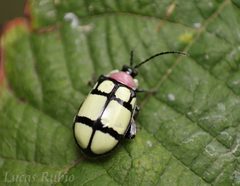
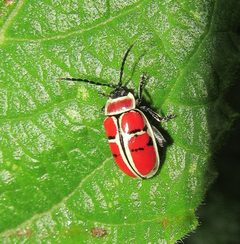
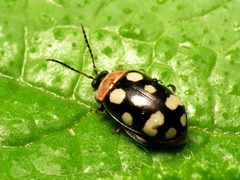
1Alagoasa is a of flea beetles (Chrysomelidae) comprising approximately 140 distributed in the Neotropics. Members possess the enlarged hind characteristic of Alticinae, enabling jumping locomotion. Several species have been investigated as agents for species, with documented specificity to Verbenaceae. The genus exhibits distinctive meiotic cytology, including direct microtubule connections between unpaired during .
Pronunciation
How to pronounce Alagoasa: //ˌæl.ə.ˈɡoʊ.sə//
These audio files are automatically generated. While they are not always 100% accurate, they are a good starting point.
Identification
Distinguished from other flea beetle by the combination of Neotropical distribution and the typical alticine : compact body, enlarged hind with thickened hind legs adapted for jumping, and often metallic coloration. -level identification requires examination of male genitalia and subtle external characters. The subgenus Oedionychus has been recognized based on internal morphology.
Images
Habitat
Associated with vegetation in Neotropical regions; specific occupy where their plants grow. Alagoasa parana occurs in southern Brazilian vegetation supporting tiliaefolia and L. glutinosa. Larval stages require moist, friable soil at the base of host plants for within silk cocoons.
Distribution
Neotropical region, with records from southern Brazil (Alagoasa parana), Puerto Rico (Alagoasa januaria), and broader South and Central American distributions implied by the -level range.
Seasonality
Alagoasa parana shows activity from October to April in southern Brazil, with adults. Abundance varies seasonally from 4-8 adults per 100 branches. with -to-adult development spanning 80-90 days during the active season.
Diet
Foliage and flowers of plants. Alagoasa parana feeds on tiliaefolia and L. glutinosa (Verbenaceae) in its native range. may produce minor feeding damage on alternative plants including Verbena bonariensis, Clerodendrum speciosissimum, Passiflora edulis, and Helianthus annuus, but complete development occurs only on Lantana .
Host Associations
- Lantana camara - Required for complete development; target for
- Lantana tiliaefolia - Native in southern Brazil
- Lantana glutinosa - Native in southern Brazil
- Verbena bonariensis - minor feeding feeding only, no development
- Clerodendrum speciosissimum - minor feeding feeding only, no development
Life Cycle
. laid in litter at base of plant. Larvae develop on foliage, then descend to pupate in moist, loose soil within silk cocoons at the host plant base. follows; adults overwinter. Complete development from egg to adult requires 80-90 days under field conditions.
Behavior
and larvae feed openly on plant foliage and flowers. Adults overwinter in sheltered positions and oviposit at the base of host plants. Jumping escape response typical of flea beetles when disturbed.
Ecological Role
Herbivore specializing on Verbenaceae, with potential to limit growth where abundant. Has been evaluated as a agent to reduce Lantana camara in Australia.
Human Relevance
Investigated as a agent for camara in Australia. Alagoasa parana and A. extrema have undergone -specificity testing for this purpose. Alagoasa parana showed high specificity, completing development only on Lantana among 55 plants tested.
Similar Taxa
- Other Alticinae generaShare jumping hind legs and general flea beetle ; distinguished by genitalia and geographic distribution
- UroplataAnother evaluated for biocontrol; differs in larval habits and
More Details
Meiotic cytology
Alagoasa (subgenus Oedionychus) exhibits unusual -I spindle organization in . and univalent are separated by a mitochondrial and move polewards at different times. Unpaired sex chromosomes remain at the periphery and are connected by microtubule bundles extending between their kinetochores, often persisting into anaphase. This distinctive has been studied using immunofluorescence and confocal microscopy.
Sources and further reading
- BugGuide
- Wikipedia
- GBIF taxonomy match
- iNaturalist taxon
- NCBI Taxonomy
- ADDITIONAL OBSERVATIONS ON THE LIFE HISTORY OF THE OEDIONYCHINA FLEABEETLES: ALAGOASA JANUARIA BECHYNE
- Microtubule distribution during meiosis I in flea-beetle[Alagoasa(Oedionychus)] spermatocytes: evidence for direct connections between unpaired sex chromosomes
- Life history and host range ofAlagoasa extrema(Coleoptera: Chrysomelidae: Alticinae), a potential biological control agent ofLantanaspp. (Verbenaceae) in Australia
- The life history, host specificity and potential of alagoasa parana Samuelson (Coleoptera: Chrysomelidae) for biological control of Lantana camara in Australia