
Eumolpus robustus
(Horn, 1885)
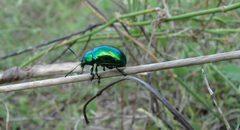
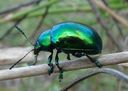
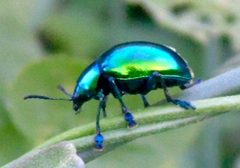
Eumolpus robustus is a leaf beetle in the Chrysomelidae, notable for having the northernmost distribution of any in its . measure 10–14 mm and display metallic green, blue, coppery, or purple coloration with strongly punctuated, shiny . The species was first described by George Henry Horn in 1885 from Arizona specimens, later synonymized with E. surinamensis, and restored as a distinct species in 1960. It feeds on plants in the family Apocynaceae.
Pronunciation
How to pronounce Eumolpus robustus: //juːˈmɒlpəs roʊˈbʌstəs//
These audio files are automatically generated. While they are not always 100% accurate, they are a good starting point.
Identification
Distinguished from other Eumolpus by its northern distribution and by the combination of metallic coloration with strongly punctuated, shiny . Separated from the similar E. surinamensis by morphological differences that led to its restoration as a distinct species in Špringlová's 1960 revision.
Images
Appearance
are 10–14 mm in length. Body coloration is metallic, appearing green, blue, coppery, or purple. The are shiny and strongly punctuated.
Distribution
Central America north to Mexico and Arizona. Recorded in Central America from Rica, Nicaragua, El Salvador, Honduras, and Guatemala. Has the northernmost range of any member of the Eumolpus.
Diet
Feeds on plants in the Apocynaceae. Associated with Gonolobus and Funastrum in Central America. Recorded from Parkinsonia in Mexico.
Host Associations
- Gonolobus - food plantCentral America
- Funastrum - food plantCentral America
- Parkinsonia aculeata - food plantMexico
Similar Taxa
- Eumolpus surinamensisFormerly synonymized with E. robustus; separated by morphological differences determined in 1960 revision
More Details
Taxonomic history
First described as Chrysochus robustus by George Henry Horn in 1885 from Arizona specimens. Horn later synonymized it with E. surinamensis (Jacoby, 1882). Restored as a distinct by Špringlová in her 1960 revision of the Eumolpus based on significant morphological differences from E. surinamensis.