
Griburius montezuma
(Suffrian, 1852)
Montezuma Griburius
Griburius montezuma is a of case-bearing leaf beetle in the Chrysomelidae. The species is distributed across Central America and North America. It has been documented at ultraviolet and mercury-vapor light traps in montane oak-pine woodland in southeastern Arizona.
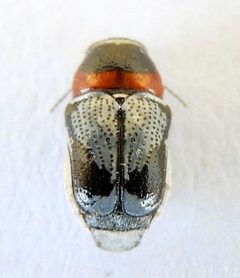
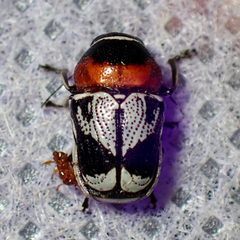
Pronunciation
How to pronounce Griburius montezuma: //ɡrɪˈbjuːriəs ˌmɒntɪˈzuːmə//
These audio files are automatically generated. While they are not always 100% accurate, they are a good starting point.
Identification
Member of the cryptocephaline leaf beetles, a characterized by case-bearing larvae that construct protective coverings from fecal material and shed . in the Griburius typically exhibit compact, rounded body forms with enlarged hind adapted for jumping. Specific diagnostic features for G. montezuma distinguishing it from are not documented in available sources.
Images
Habitat
Montane oak-pine woodland. Documented from blacklighting setups in riparian montane oak woodland and adjacent campground areas.
Distribution
Central America and North America. Specific country records include Mexico and the United States (Arizona). GBIF records indicate presence in Middle America and North America, with a specific record from Colombia.
Seasonality
have been collected in early June in southeastern Arizona, suggesting late spring to early summer activity in that region.
Life Cycle
As a member of the Cryptocephalinae, larvae are case-bearers that construct portable protective cases from fecal material and . Specific details for G. montezuma are not documented.
Behavior
are attracted to ultraviolet and mercury-vapor lights at night. Has been observed coming to light setups in montane oak-pine woodland .
Similar Taxa
- Other Griburius species share the compact body form and enlarged hind characteristic of the . Distinguishing G. montezuma from other in the genus requires examination of specific morphological characters not detailed in available sources.
More Details
Collection method
Documented specimen was collected using combined ultraviolet and mercury-vapor light trapping, a standard method for attracting nocturnally active beetles.