
Physonota
Boheman, 1854
tortoise beetles, hispines
Species Guides
6- Physonota alutacea(wild olive tortoise beetle)
- Physonota arizonae(Arizona tortoise beetle)
- Physonota calochroma
- Physonota disjuncta
- Physonota helianthi(Sunflower Tortoise Beetle)
- Physonota unipunctata(horsemint tortoise beetle)
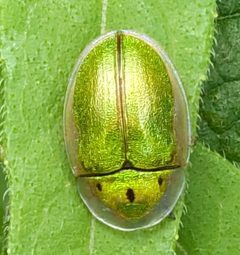
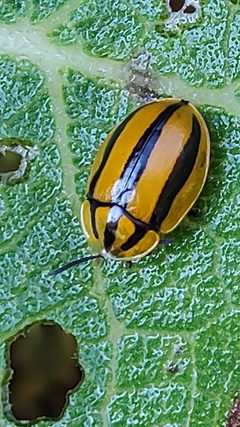
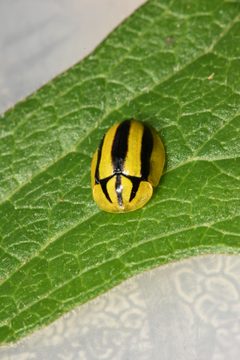
Physonota is a of tortoise beetles and hispines in the Chrysomelidae, containing more than 40 described . Species in this genus are distributed across North America, with records from the United States and Canada. The larvae possess distinctive defensive structures: shields made of and held over the body using urogomphi. plant associations have been documented for some species, though many remain poorly studied.
Pronunciation
How to pronounce Physonota: /ˌfaɪsəˈnoʊtə/
These audio files are automatically generated. While they are not always 100% accurate, they are a good starting point.
Identification
Members of this can be recognized as tortoise beetles by the broadly expanded, shield-like that cover the body and often the legs. As a genus-level , specific identification features require examination of individual . Larvae are distinguished by the presence of urogomphi— structures used to hold a fecal shield over the body for defense.
Images
Habitat
Associated with plants; specific requirements vary by . One species has been documented in the vicinity of Montreal, Canada, where it occurs in areas supporting its food plant.
Distribution
North America. Documented from the United States (including Colorado and Vermont) and Canada (Montreal area). The has a broader distribution with over 40 , though detailed range data for most species is limited.
Seasonality
of at least one (P. unipunctata) have been observed with first appearing in June in the Montreal area; early May searches were unsuccessful as the food plant had not yet emerged.
Host Associations
- food plant - herbivoreSpecific plant not identified in available sources for P. unipunctata; first host plant association documented for P. disjuncta but not specified in provided text.
Life Cycle
Larval stage characterized by construction of defensive shields from and shed (), held over the body using urogomphi. First of at least one appears in June.
Behavior
Larvae hold fecal shields over their bodies like umbrellas as a defense against . This has been photographed in Colorado.
Ecological Role
Herbivores associated with specific plants; role in dynamics not well documented.
Similar Taxa
- Other Cassidinae generaShare the tortoise beetle with expanded ; Physonota distinguished by tribal placement in Ischyrosonychini and specific larval shield structures.
More Details
Larval Defense
The fecal shield is a notable defensive . Larvae attach the shield to urogomphi—paired structures extending from the —and can maneuver it to block . This has been documented photographically in Colorado specimens.
Taxonomic History
Historical confusion exists regarding boundaries within the , particularly surrounding P. unipunctata and varieties described by Say, Randall, and Walsh and Riley.
Sources and further reading
- BugGuide
- Wikipedia
- GBIF taxonomy match
- iNaturalist taxon
- NCBI Taxonomy
- Catalogue of Life
- - Entomology Today
- ON PHYSONOTA UNIPUNCTATA Say, AND ITS SUPPOSED VARIETIES
- First United States Record for Physonota disjuncta (Chevrolat, 1834) and a First Host Plant Association (Coleoptera: Chrysomelidae: Cassidinae: Ischyrosonychini)