
Caryobruchus gleditsiae
(Johansson & Linnaeus, 1763)
Palm Seed Weevil
Caryobruchus gleditsiae is a seed beetle in the Chrysomelidae (formerly Bruchidae), notable as the largest bruchid in the United States. range from 4 to 11 mm in length, with body size determined by the size of the palm seed in which the larva developed. The species develops exclusively inside palm seeds and has been recorded from at least 11 in the Arecaceae family. It is widely distributed across the New World and has been introduced to the Old World.
Pronunciation
How to pronounce Caryobruchus gleditsiae: //ˌkærioʊˈbruːkəs ɡlɛˈdɪtsiae//
These audio files are automatically generated. While they are not always 100% accurate, they are a good starting point.
Identification
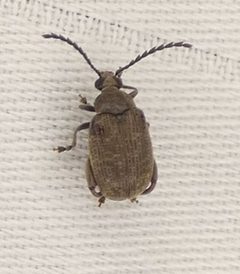
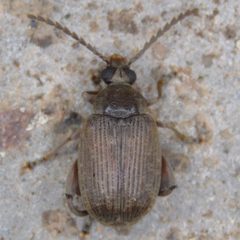
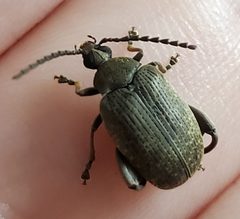
Distinguished from other bruchids by its large size (up to 11 mm, largest in U.S. Bruchidae), black body with gray hairs and scattered white elytral spots. Differs from : C. mariae occurs only on Cuba, and C. maya is restricted to southern Mexico, Belize, and Guatemala. The plastic size, dependent on larval seed size, can cause confusion with smaller individuals of other .
Images
Habitat
Associated with palm-dominated where palms occur. Develops inside palm seeds that have been partially processed—specifically, seeds with the exocarp and mesocarp removed, exposing the hard endocarp. This preprocessing is typically accomplished by rodents.
Distribution
Native to the New World: southeastern United States, Mexico, Central America, West Indies, and Bahamas. Introduced to the Old World. Distribution records based on museum specimens confirm presence in Caribbean, Middle America, and North America.
Diet
Obligate seed of palms (Arecaceae). Larvae feed endophytically within palm seeds. Recorded plants include multiple Sabal (S. bermuda, S. causiarum, S. domingensis, S. etonia, S. glabra, S. longipedunculata, S. mexicana, S. minor, S. palmetto, S. parviflora, S. rosei, S. uresana, S. yapa), plus Coccothrinax argentata, Copernicia sp., Phoenix sylvestris, Livistona chinensis, Roystonea sp., Thrinax microcarpa, and Washingtonia filifera.
Host Associations
- Sabal bermuda - larval seed
- Sabal causiarum - larval seed
- Sabal domingensis - larval seed
- Sabal etonia - larval seed
- Sabal glabra - larval seed
- Sabal longipedunculata - larval seed
- Sabal mexicana - larval seed ; damage rates 3.48-77.77% observed in Sinaloa, Mexico
- Sabal minor - larval seed
- Sabal palmetto - larval seed ; damage rates 3.48-77.77% observed in Sinaloa, Mexico
- Sabal parviflora - larval seed
- Sabal rosei - larval seed
- Sabal uresana - larval seed ; damage rates 3.48-77.77% observed in Sinaloa, Mexico
- Sabal yapa - larval seed
- Coccothrinax argentata - larval seed
- Copernicia - larval seed , level
- Phoenix sylvestris - larval seed
- Livistona chinensis - larval seed
- Roystonea - larval seed , level
- Thrinax microcarpa - larval seed
- Washingtonia filifera - larval seed
Life Cycle
Female deposits a single on the exterior of a palm seed. Oviposition occurs only on seeds with exocarp and mesocarp removed, exposing the smooth endocarp. Larva hatches and uses sharp, heavy to bore into the hard seed. Complete larval development occurs within the seed; size is determined by seed size. No natural enemies are known.
Behavior
Oviposition is selective: females lay only on palm seeds that have been partially depulped, typically by rodent activity. Larvae possess specialized heavy for penetrating hard palm endocarps. Seed rates can be highly variable, ranging from 3.48% to 77.77% in observed .
Ecological Role
Specialized seed of palms. Acts as a significant mortality factor for palm seeds, with rates occasionally exceeding three-quarters of available seeds in local . Interaction with rodents is facilitative: rodent seed processing enables oviposition by exposing suitable substrates.
Human Relevance
Minor economic significance as a pest of ornamental palm seeds. The original specific epithet (gleditsiae) reflects a historical misidentification of the as honey locust (Gleditsia triacanthos), a mistake corrected when the true palm-feeding was established.
Similar Taxa
- Caryobruchus mariaeClosely related restricted to Cuba; distribution distinguishes it from C. gleditsiae
- Caryobruchus mayaClosely related found in southern Mexico, Belize, and Guatemala; partial geographic overlap but not throughout full range of C. gleditsiae
Misconceptions
The specific epithet 'gleditsiae' perpetuates Linnaeus's original error that the developed in honey locust (Gleditsia triacanthos). This association was incorrect; the is exclusively associated with palms (Arecaceae).
More Details
Taxonomic history
First described by Linnaeus in 1763 as Dermestes gleditsiae. Transferred to Caryobruchus by Bridwell in 1929, who designated it the type . Redescribed by Nilsson & Johnson in 1990; original lost and no neotype designated.
Family placement
Traditionally classified in Bruchidae, now treated as Bruchinae within Chrysomelidae in modern classifications.