
Callosobruchus phaseoli
(Gyllenhal, 1833)
cowpea weevil, bean weevil
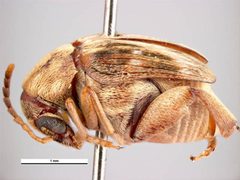
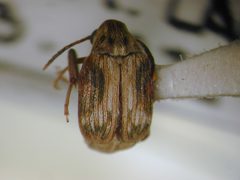
Callosobruchus phaseoli is a seed beetle in the Chrysomelidae, Bruchinae, commonly known as the cowpea weevil. Native to India, it has become a widespread pest of legume crops across tropical and subtropical regions worldwide. emerge from infested seeds and immediately mate, with females beginning -laying on the same day. The causes significant damage to stored legume seeds and is known to exhibit during larval development.
Pronunciation
How to pronounce Callosobruchus phaseoli: //kəˌloʊsoʊˈbruːkəs fæzɪˈoʊlaɪ//
These audio files are automatically generated. While they are not always 100% accurate, they are a good starting point.
Images
Habitat
Agricultural lands, storage facilities, and natural landscapes where legumes occur. Infests seeds both in field conditions and post-harvest storage.
Distribution
Native to India. Introduced and established across South and Central America, North America, Europe, Middle East (Israel), North Africa, Arabian Peninsula, Far East, China, Japan, Sri Lanka, Indonesia, Burma, Philippines, Hawaiian Islands, Australia, Oceania, and Kazakhstan (first recorded in Almaty city). Predicted to spread further in southern and southeastern Kazakhstan.
Diet
Seeds of leguminous plants (Fabaceae).
Host Associations
- Vigna angularis - adzuki bean
- Vigna radiata - mung bean
- Vigna unguiculata - cowpea
- Vicia faba - broad bean
- Pisum sativum - pea
- Cajanus cajan - pigeon pea
- Lablab purpureus - hyacinth bean
- Wisteria sp. -
- Phaseolus lunatus - lima bean
- Phaseolus vulgaris - common bean
- Cicer arietinum - chickpea
- Sesbania sp. -
- Crotalaria spectabilis - rattlepod
- Lupinus sp. - lupine
Life Cycle
Complete with , larva, pupa, and stages. Larval development occurs entirely within seeds.
Behavior
Emerged immediately mate and begin -laying on the same day. Exhibits strategy during larval development, with larvae competing exploitatively for resources throughout all larval stages. Males engage in fighting with larger males having advantage in contests. Multiple mating occurs.
Ecological Role
Agricultural pest of legume crops. to including Eupelmus pulchriceps (Eupelmidae).
Human Relevance
Significant economic pest of stored legume seeds worldwide. Causes damage to multiple bean, pea, and lentil crops both pre- and post-harvest. with potential for continued range expansion via trade routes.
Similar Taxa
- Callosobruchus analisSimilar seed beetle and ; distinguished by competition strategy (C. analis exhibits contest competition, C. phaseoli exhibits ) and interference timing (C. analis shows interference only at late larval stages)
- Callosobruchus maculatusCongeneric seed beetle with overlapping range and distribution; precise distinguishing features require examination of genitalia and subtle morphological characters
- Caliothrips phaseoliName similarity only; this is a thrips (Thysanoptera: Thripidae), not a , with entirely different and
Sources and further reading
- BugGuide
- Wikipedia
- GBIF taxonomy match
- iNaturalist taxon
- NCBI Taxonomy
- Thripidae | Beetles In The Bush
- Leguminosae | Blog
- Callosobruchus phaseoli (Gyllenhal, 1833) (Coleoptera, Chrysomelidae, Bruchinae): a new invasive species in Kazakhstan
- Primer reporte de Eupelmus pulchriceps (Hymenoptera:Eupelmidae) parasitando Callosobruchus phaseoli (Coleoptera:Chrysomelidae) plaga de Cajanus cajan en Panamá
- Contest and scramble competitions in two bruchid species, Callosobruchus analis andC. phaseoli (Coleoptera: Bruchidae)