
Ptilodactyla
Illiger, 1807
toe-winged beetles
Species Guides
6- Ptilodactyla angustata(toe-winged beetle)
- Ptilodactyla carinata(toe-winged beetle)
- Ptilodactyla hyperglotta
- Ptilodactyla isoloba
- Ptilodactyla nanoderma
- Ptilodactyla serricollis(toe-winged beetle)
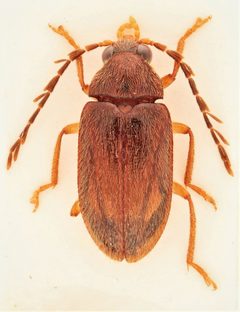
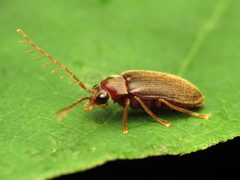
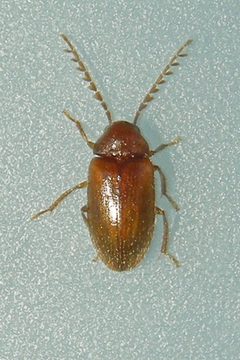
Ptilodactyla is a large and of toe-winged beetles comprising approximately 370–380 described , representing roughly 70% of all species in the Ptilodactylidae. The genus is characterized by distinctive morphological features including pectinate male with articulated rami, incomplete lateral pronotal carinae anteriorly, concealed , and pseudotetramerous with reduced tarsomere IV and lobed tarsomere III. Fossil records extend to the Eocene, with specimens described from Baltic amber (Russia) and Rovno amber (Ukraine). Some species have been introduced outside their native ranges through human activity.
Pronunciation
How to pronounce Ptilodactyla: //ˌtaɪloʊˈdæktɪlə//
These audio files are automatically generated. While they are not always 100% accurate, they are a good starting point.
Identification
Males possess pectinate with articulated rami, a key diagnostic feature. Additional distinguishing characters include: lateral pronotal carina anteriorly incomplete; concealed; pseudotetramerous with tarsomere IV reduced and tarsomere III lobed ventrally; claws bearing a basal tooth; scutellar shield typically -shaped; and palpomeres mostly sclerotized and securiform (ax- or hatchet-shaped).
Images
Habitat
Associated with riparian, semiaquatic, and aquatic environments. Larvae inhabit soil and possess various adaptations for underwater survival. Some have established in indoor environments rich in organic substrates and ornamental plants.
Distribution
Worldwide distribution; not native to present-day Europe though occur in the western Palearctic. Native range includes the Mascarene Islands (e.g., Réunion Island) for some species. Introduced documented in the United States and at least eleven European countries. Fossil records from Eocene Baltic amber (Sambian Peninsula, Kaliningrad Oblast, Russia; ~48–34 Ma) and Rovno amber (Ukraine).
Diet
Larvae feed on fungus-infested, decaying organic matter. diet not documented in available sources.
Life Cycle
Larvae are soil-dwelling with documented adaptations for survival underwater. Specific details on , longevity, and time not available.
Behavior
Some have been accidentally introduced to new regions through human-mediated transport and can establish persistent indoor .
Human Relevance
Ptilodactyla exotica and potentially other are accidental introductions to human-built environments, where they may persist in office buildings and similar structures with suitable organic substrates. The has significance for understanding evolution and given its extensive fossil record.
Sources and further reading
- BugGuide
- Wikipedia
- GBIF taxonomy match
- iNaturalist taxon
- NCBI Taxonomy
- Catalogue of Life
- The First Ptilodactyla Illiger, 1807 (Coleoptera: Dryopoidea: Ptilodactylidae) Described from Eocene Baltic Amber
- The first record of alien beetle species Ptilodactyla exotica Chapin, 1927 (Coleoptera: Dryopoidea: Ptilodactylidae) in Poland
- Revealing Palaeogene distribution of the Ptilodactylidae (Insecta: Coleoptera): the first Ptilodactyla Illiger, 1807 records from Rovno amber of Ukraine