
Stegobium
Motschulsky, 1860
drugstore beetle (S. paniceum), bread beetle (S. paniceum), biscuit beetle (S. paniceum)
Species Guides
1- Stegobium paniceum(Drugstore Beetle)
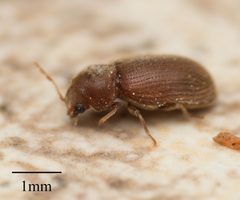
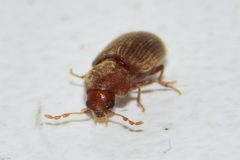
Stegobium is a of small beetles in the Ptinidae (formerly Anobiidae), with Stegobium paniceum being the only extant . The genus contains economically important stored product pests known for their ability to infest diverse dried plant materials. These beetles harbor yeast-like (Symbiotaphrina species) that enable digestion of nutrient-poor substrates. are attracted to ultraviolet light and females emit that peak 3–4 days after , synchronized with ovarian maturation.
Pronunciation
How to pronounce Stegobium: //stɛˈɡoʊbiəm//
These audio files are automatically generated. While they are not always 100% accurate, they are a good starting point.
Images
Habitat
Stored product environments including warehouses, pantries, museums, and libraries. Infests dried plant materials such as cereals, medicinal herbs, tobacco products, and flour-based materials. Museum specimens have been found in glue paste linings of oil paintings, where larvae tunnel through the middle support layer between original canvas and lining canvas.
Distribution
distribution associated with human commerce and stored products. Documented in Europe (Denmark, Norway, Sweden per GBIF), Asia (Taiwan, Japan), and North America. studied from multiple origins show stable associations across geographic ranges.
Diet
Dried plant products including cereals, flour, bread, biscuits, medicinal herbs, pharmaceuticals, tobacco, dried fish, leather, and upholstery. Larvae specifically feed on glue paste (flour-based adhesive) used in art conservation to line oil paintings.
Host Associations
- Symbiotaphrina buchneri - mutualistic Yeast-like harbored intracellularly in mycetomes; transmitted vertically via surface smearing
- Symbiotaphrina kochii - mutualistic Alternative yeast-like strain found in some
- Symbiotaphrina sp. (novel clade) - mutualistic Unidentified Symbiotaphrina detected in most S. paniceum ; represents overlooked diversity
- Lariophagus distinguendus - Pteromalid used in ; locates using larval as olfactory cue
Life Cycle
Complete with , larva, pupa, and stages. Female adults harbor extracellular yeast-like in intersegmental tubules connected to reproductive organs; symbionts are smeared on egg surfaces during oviposition. Newly hatched larvae consume eggshell material to acquire symbionts. Larvae feed and develop within substrate, creating tunnels in glue paste and canvas. occurs in constructed from food materials; adults emerge through exit holes in lining canvas or gummed tape. Minimum feeding requirement: approximately 6 cubic millimeters of food from egg to pupa.
Behavior
exhibit positive , with strong attraction to ultraviolet (UV) light over blue light when intensities are equal. Females emit beginning 2–3 days after , peaking at 3–4 days; emission oscillates markedly after mating. Mating induces increased activity, refractory , and behavior in females. Flight occurrence increases after oviposition begins and decreases when oviposition is complete. Larval feeding in paintings concentrated in shaded areas covered by stretcher and outer frame.
Ecological Role
Economically significant stored product pest. Mutualistic with yeast-like enables utilization of nutrient-poor diets through supplementation of B-vitamins, sterols, and . in museums create microenvironments supporting secondary pests including booklice (Liposcelis) and (Limothrips).
Human Relevance
Major pest of stored food products, medicinal herbs, and museum collections. Responsible for damage to over 80 paintings in a single museum in Taiwan (2008), with larvae tunneling through glue paste linings and causing paint loss through canvas damage. Subject of research including UV light trapping and using .
Similar Taxa
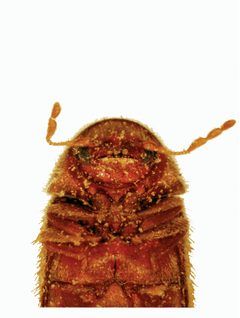
- Lasioderma serricorneCigarette beetle; similar size, appearance, and stored product pest . Distinguished by with serrated club (Stegobium has three-segmented club) and different orientation. Both attracted to UV light and used in comparative studies.
- Oryzaephilus surinamensisSawtoothed grain beetle; similar pantry pest status but distinguished by six sawtoothed projections on each side of prothorax and different body shape.
Sources and further reading
- BugGuide
- GBIF taxonomy match
- iNaturalist taxon
- NCBI Taxonomy
- Oh, the Bugs They Saw at the Bohart! | Bug Squad
- drugstore beetle (Stegobium paniceum) - Entomology Today
- Stegobium paniceum Archives - Entomology Today
- A Taste for Paste: Beetle Larvae Fond of Museum Paintings' Glue Lining
- UV Light Best for Luring Cigarette and Drugstore Beetles
- artwork layers - Entomology Today
- Diversity of yeast-like Symbiotaphrina symbionts in the stored product pests Lasioderma serricorne and Stegobium paniceum
- Sex pheromone emission by female Stegobium paniceum (L.) (Coleoptera: Anobiidae) in relation to reproductive maturation and oviposition
- Post‐mating changes in the behaviour and activity of the female anobiid bread beetle, Stegobium paniceum
- Using parasitoid wasps in Integrated Pest Management in museums against biscuit beetle (Stegobium paniceum) and webbing clothes moth (Tineola bisselliella)
- CERTAIN BIOLOGICAL ASPECTS OF THE STORED DRUG BEETLE, (Stegobium paniceum L.) (COLEOPTERA : ANOBIIDAE) ON DIFFERENT APIACEAE HOSTS
- Mating behaviour and the mechanism of male orientation in the anobiid bread beetle, Stegobium paniceum
- Following a scented beetle: larval faeces as a key olfactory cue in host location of Stegobium paniceum (Coleoptera: Anobiidae) by Lariophagus distinguendus (Hymenoptera: Pteromalidae)
- The stored product beetles Lasioderma serricorne and Stegobium paniceum are associated with a flexible and hidden diversity of Symbiotaphrina symbionts.