
Trogoderma anthrenoides
(Sharp, 1902)
Trogoderma anthrenoides is a stored-product pest in the Dermestidae. Laboratory studies indicate it develops between 17.5-37.5°C at 70% relative humidity, with optimal production at 27.5°C. The has been assessed as having only minor pest potential compared to more damaging relatives like T. granarium. Some larvae enter facultative under adverse conditions. The species has been recorded in North America, Oceania, and Colombia.
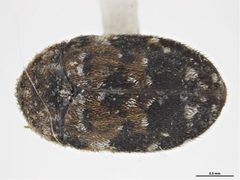
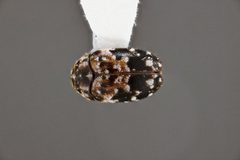
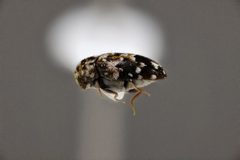
Pronunciation
How to pronounce Trogoderma anthrenoides: /ˌtrɒɡəˈdɜːrmə ænˌθriːˈnɔɪdiːz/
These audio files are automatically generated. While they are not always 100% accurate, they are a good starting point.
Images
Habitat
Stored product environments, particularly where relative humidity around 70% can be maintained. Laboratory studies indicate association with food storage settings, though specific natural preferences have not been documented.
Distribution
Recorded in North America, Oceania, and Colombia. GBIF distribution records indicate presence in these regions without specific locality details for Colombia.
Diet
Larvae require food for development; specific food types not documented in available sources. females apparently require no food.
Life Cycle
Complete with , larval, pupal, and stages. At 35°C and 70% RH, development takes approximately 44.7 days total: egg (6 days), larva (34.3 days), pupa (4.4 days). Male larvae develop slightly faster than females. Some larvae can enter facultative , which is terminated by increased food volume combined with temperature change.
Behavior
Larvae may enter facultative under adverse conditions, a reversible state that can be terminated by environmental cues including increased food availability and temperature change.
Ecological Role
Minor pest of stored products. Laboratory studies concluded the has only minor pest potential and shows no signs of becoming a serious pest, unlike T. granarium.
Human Relevance
Minor stored-product pest with limited economic impact compared to more damaging dermestid relatives. Laboratory assessment indicates low serious pest potential.
Similar Taxa
- Trogoderma granariumT. granarium is a major grain pest causing up to 70% spoilage, whereas T. anthrenoides has been assessed as having only minor pest potential with different temperature tolerances and characteristics.
- Trogoderma parabileShares facultative and similar ; both are considered minor pests rather than serious agricultural threats.
- Trogoderma inclusumSimilar and minor pest status; T. anthrenoides resembles these two minor pests more than the serious pest T. granarium.
More Details
Taxonomic Note
The has been synonymized as Trogoderma serraticorne in some sources (iNaturalist, Wikipedia), though GBIF and NCBI retain T. anthrenoides as the accepted name.
Laboratory Development Data
At 70% RH: minimal developmental temperature 17.5-20°C, maximum 35-37.5°C. Fastest development at 35°C; optimal production at 27.5°C. Near-zero humidity prevents larval development and reduces lifespan.
Sources and further reading
- BugGuide
- GBIF taxonomy match
- iNaturalist taxon
- NCBI Taxonomy
- Oh, the Bugs They Saw at the Bohart! | Bug Squad
- Trogoderma glabrum: The Benjamin Button of the Insect World
- khapra beetle - Trogoderma granarium - lateral view - Entomology Today
- warehouse beetle (Trogoderma variabile) - Entomology Today
- New Analysis Refines Taxonomy of Dermestid Beetles
- Khapra Beetle Can't Beat the Heat
- Effect of temperature and humidity onTrogoderma anthrenoides(Sharp)(Coleoptera, Dermestidae) and comparisons with related species