
Myxophaga
Minute Bog and Skiff Beetles
Family Guides
2- Hydroscaphidae(skiff beetles)
- Sphaeriusidae(Minute Bog Beetles)
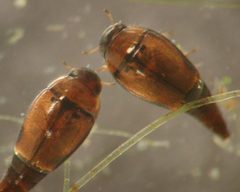
is a small suborder of Coleoptera comprising approximately 65 described across four extant : , Hydroscaphidae, Sphaeriusidae, and Torridincolidae. These beetles are among the smallest in the order, ranging from small to minute in size. All members are aquatic or semiaquatic, with many species inhabiting hygropetric environments—thin water films on rock surfaces in running water. The suborder is characterized by distinctive morphological features including clubbed with fewer than nine segments, open mesocoxal cavities, and apically rolled hind wings in resting position.
Pronunciation
How to pronounce Myxophaga: /mɪkˈsɒfəɡə/
These audio files are automatically generated. While they are not always 100% accurate, they are a good starting point.
Identification
Distinguished from other Coleoptera suborders by combination of: clubbed with <9 segments; mesocoxal cavities open laterally and bordered by mesepimeron and metanepisternum; hind wings rolled apically when at rest; six (internal); tube-like coiled (internal). Larvae distinguished by miniaturization, flattened body with laterally extended tergites, broad , and -like surface structures. Mouthparts diagnostic: lacking , with mobile tooth on left . distinguished by preference and body form—Torridincolidae often ovoid with semicircular ; Hydroscaphidae and Sphaeriusidae more streamlined.
Images
Appearance
Extremely small beetles, with most measuring only 0.5–2.0 mm in length. Body form varies by but generally compact and often somewhat flattened. distinctly clubbed with typically 8 or fewer segments. Hind wings, when present, are rolled apically at rest rather than folded. Larvae show marked miniaturization with flattened bodies and laterally extended tergites; capsule broadened. -like surface structures present on body. Spiracular gills present in larvae of some families, appearing balloon-shaped.
Habitat
Strictly aquatic to semiaquatic environments. Many inhabit hygropetric —thin films of water flowing over rock surfaces in streams and waterfalls. Some occur in moss-associated water films, algal mats, or spaces in gravel. Larvae of Torridincolidae, Hydroscaphidae, and Sphaeriusidae show particular to life on rocks in running water with current.
Distribution
: northern South America and Central America. Hydroscaphidae: all continents except Australia and Antarctica. Sphaeriusidae: all continents except Antarctica. Torridincolidae: Africa, Asia, and South America. The suborder thus shows a disjunct global distribution with major gaps in Australia (no Hydroscaphidae) and Antarctica (no extant ).
Diet
Feeds on . Mouthpart specifically adapted for algal consumption: lack of and presence of mobile tooth on left are characteristic modifications for this diet.
Life Cycle
Complete with , larval, pupal, and stages. Larvae aquatic, with some possessing spiracular gills for respiration in wet environments. occurs within last larval in at least some families. Specific details of egg deposition and developmental timing vary by family and remain poorly documented for many .
Behavior
Strongly associated with wetted substrates; and larvae cling to rock surfaces in flowing water. Tendency toward miniaturization and flattened body form facilitates movement in thin water films and crevices. Limited capability suggested by restricted distributions and specific requirements.
Ecological Role
Primary consumers in aquatic , converting algal to animal tissue. Serve as prey for larger aquatic and small vertebrates. Contribute to nutrient cycling in hygropetric and stream-edge where they are often among the few insect adapted to these marginal aquatic .
Human Relevance
No direct economic importance. Occasionally encountered by aquatic biologists and entomologists in stream surveys. Extremely small size makes them unlikely to be noticed by general public. Some serve as indicators of clean, well-oxygenated flowing water .
Similar Taxa
- ArchostemataOther small suborder of Coleoptera, but Archostemata have or serrate (not clubbed), and different wing folding mechanism; includes more primitive such as Cupedidae and Micromalthidae.
- AdephagaLarge suborder of mostly predatory aquatic beetles (e.g., Dytiscidae, Gyrinidae), but Adephaga have , different hind wing folding, and lack the specific mouthpart modifications for algal feeding seen in .
- PolyphagaLargest and most diverse suborder of Coleoptera; includes some aquatic (e.g., Hydrophilidae) but these have different structure, body form, and lack the diagnostic combination of myxophagan characters including the specific larval adaptations and wing folding.
More Details
Phylogenetic significance
represents one of the earliest diverging lineages of Coleoptera, though its exact position relative to Archostemata has been debated. The fossil record includes Triamyxa from the Late Triassic (~232-227 mya), among the oldest known beetles, and Leehermania from the Late Triassic of North America. These fossils help establish the antiquity of aquatic lineages.
Miniaturization effects
Extreme miniaturization in has led to significant morphological simplification and novel structural arrangements, including fusion of and reduction in segment numbers. This has complicated phylogenetic analysis and may obscure with larger relatives.
Sources and further reading
- BugGuide
- Wikipedia
- iNaturalist taxon
- NCBI Taxonomy
- Catalogue of Life
- Archostemata-Myxophaga-Adephaga
- American beetles: v.1: Archostemata, myxophaga, adephaga, polyphaga: staphyliniformia
- Phylogenetic analysis of Myxophaga (Coleoptera) using larval characters
- Catalogue of Palaearctic Coleoptera, Volume 1. Archostemata - Myxophaga - Adephaga.
- Australian Beetles Volume 2
- New Fossil Megalopteran and Megalopteran-like Larvae, a First Extinct Larval Morphology of Megaloptera, and Possible Larvae of Myxophagan Beetles.