
Blattella vaga
Hebard, 1935
Field Cockroach
Blattella vaga, the field , is a small outdoor-dwelling cockroach in the Ectobiidae. First described from Arizona and California in 1935, it has since been recorded across North America and introduced to parts of Europe, Asia, and Australia. It resembles the German cockroach (Blattella germanica) but is not a significant indoor pest, typically entering buildings only during hot or dry conditions. The harbors bacterial gut with demonstrated antimicrobial properties.
Pronunciation
How to pronounce Blattella vaga: //blæˈtɛl.lə ˈvaː.ɡə//
These audio files are automatically generated. While they are not always 100% accurate, they are a good starting point.
Identification
Resembles Blattella germanica (German cockroach) and Blattella asahinai (Asian cockroach) in size and pronotal striping. Distinguished by outdoor preference and tendency to enter buildings only during hot or dry conditions rather than establishing indoor . capability noted. Visual examination of ground litter required for collection, indicating more secretive, ground-dwelling than peridomestic .
Images
Appearance
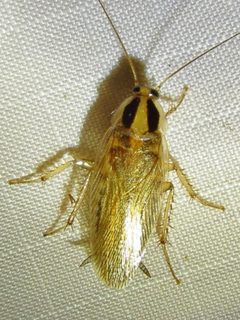
Small resembling Blattella germanica, with showing longitudinal stripes on the pronotum. Similar body length to . Wings present and functional for .
Habitat
Primarily outdoor; found in humus around trees and shrubs, leaf litter, and semi-wild environments. Peridomestic—occasionally enters buildings during hot or dry weather but does not establish indoor . Collected from Wadi Namar Dam and Wadi Hanifa near Riyadh, Saudi Arabia; former site with potential sewage , latter relatively cleaner. Tolerates polluted conditions.
Distribution
Native to North America: originally described from Arizona and California; GBIF records indicate presence across northwestern, north-central, northeastern, southwestern, and south-central USA. Introduced to Europe, Northern Asia (excluding China), Southern Asia, Central America, and Australia. Established in Saudi Arabia (Riyadh province).
Behavior
; attracted to lights. Capable of . Ground-dwelling and secretive, requiring visual search of humus and leaf litter for collection. Can persist in polluted environments for extended periods. Does not reproduce indoors.
Ecological Role
Source of bacterial gut with pharmaceutical potential. Isolated Bacillus licheniformis, Bacillus subtilis, and Kocuria rosea from Saudi Arabian ; B. licheniformis showed strong antimicrobial activity against Candida albicans, and K. rosea against MRSA and Streptococcus mutans. Gut likely contributes to and resistance.
Human Relevance
Minimal pest status; occasionally mistaken for German cockroach when entering buildings, but not a persistent indoor pest. Not known to transmit or cause significant economic damage. Subject of scientific interest for bacterial with antimicrobial properties.
Similar Taxa
- Blattella germanicaSimilar size and pronotal striping; distinguished by indoor preference and persistent pest versus outdoor, occasional indoor presence in B. vaga
- Blattella asahinaiSimilar appearance and outdoor ; both attracted to lights and capable of
Misconceptions
Often mistaken for German cockroach when found indoors, but does not establish indoor or reproduce in buildings.
More Details
Bacterial Symbionts
First study to isolate and identify gut bacterial from this , conducted on Saudi Arabian . Three gram-positive species identified: Bacillus licheniformis, Bacillus subtilis, and Kocuria rosea. Antimicrobial screening showed B. licheniformis effective against Candida albicans; K. rosea effective against MRSA and Streptococcus mutans.
Wolbachia Status
Screened for in 2022 study; not found to harbor this endosymbiotic bacterium, unlike some and other .
Sources and further reading
- BugGuide
- Wikipedia
- GBIF taxonomy match
- iNaturalist taxon
- NCBI Taxonomy
- A New Cockroach in Town? | Bug Squad
- The Day That Cockroaches Stole the Show | Bug Squad
- Wolbachia in Cockroaches: A New Paradigm for Urban Pest Management?
- Unwelcome guests in Hawai’i: American cockroach, Periplaneta americana, German cockroach, Blattella germanica, and Western yellowjacket, Vespula pensylvanica — Bug of the Week
- Turn on the light, a cockroach delight. Oriental Cockroach Blatta orientalis and German cockroach Blattella germanica — Bug of the Week
- In Search for Effective Cockroach Lures, Apple and Blueberry Come Out on Top
- Evaluation of antimicrobial activity of bacterial symbionts isolated from wild field cockroach Blattella vaga from Saudi Arabia.