
Sminthurinus henshawi
(Folsom, 1896)
Henshaw's globular springtail
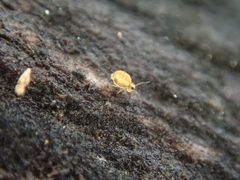
Sminthurinus henshawi is a of globular springtail in the Katiannidae. It is a small, soil-dwelling hexapod with a characteristic rounded body shape. The species has been recorded across multiple continents including North America and Eurasia. It is one of the more frequently observed species, with over 1,400 citizen science records.
Pronunciation
How to pronounce Sminthurinus henshawi: /smɪnˈθjʊrɪnəs hɛnˈʃɔːwi/
These audio files are automatically generated. While they are not always 100% accurate, they are a good starting point.
Identification
Distinguishing S. henshawi from other Sminthurinus requires examination of chaetotaxy (bristle arrangement) and genital structures under magnification. The globular body form separates it from elongate springtails (Entomobryomorpha). Within Katiannidae, species-level identification relies on microscopic characters not visible in field observations.
Images
Appearance
As a globular springtail in the order Symphypleona, the body is rounded and compact, with the to the . The body shape is spherical to ovoid when viewed from above. Like other Katiannidae, it possesses a (springing organ) folded beneath the for escape locomotion. Specific coloration and size details for this are not documented in available sources.
Habitat
Found in soil and leaf litter environments. Specific microhabitat preferences for this are not documented.
Distribution
Recorded from northern Eurasia, northern North America, Pacific North America, and southern North America. The broad distribution suggests to temperate climates across both the Palearctic and Nearctic regions.
Behavior
Possesses a for saltatorial (jumping) escape response when disturbed, characteristic of Collembola.
Ecological Role
Functions as a decomposer in soil , contributing to nutrient cycling through consumption of decaying organic matter. This role is inferred from the ecological function of Collembola generally, though specific studies on S. henshawi are not documented.
Similar Taxa
- Other Sminthurinus speciesShare globular body form and -level characteristics; require microscopic examination for separation
- Other KatiannidaeSimilar size and ; differentiated by genitalic and chaetotaxic characters
More Details
Taxonomic history
First described by J.W. Folsom in 1896. The has remained in the Sminthurinus with no documented synonymy.
Observation frequency
With 1,447 iNaturalist observations, this is among the more commonly recorded , likely reflecting both its actual abundance and the relative ease of recognizing the Sminthurinus in photographs.