
Ptenothrix maculosa
(Schött, H, 1891)
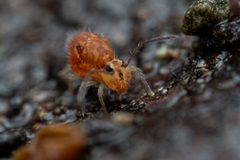
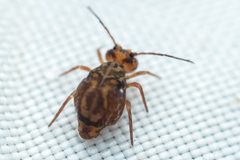
Ptenothrix maculosa is a globular springtail in the Dicyrtomidae, native to the temperate west coast of North America from Alaska to California. First described by Swedish entomologist Henrik Schött in 1891, this exhibits extreme color , leading to decades of misidentification and the synonymization of several conjectured undescribed species. Definitive identification requires microscopic examination of setal arrangements on the and furca. It serves as a decomposer in woodland and has become a focal species for citizen science monitoring through photo-based identification.

Pronunciation
How to pronounce Ptenothrix maculosa: /ˌptɛnoʊˈθrɪks ˌmækjʊˈloʊsə/
These audio files are automatically generated. While they are not always 100% accurate, they are a good starting point.
Identification
Definitive identification requires microscopic examination of abdominal and furcal setae. Photo identification is possible for experienced observers using documented visual patterns, but has historically been unreliable due to extreme color variation and similarity to sympatric Ptenothrix . Key confusion species include P. delongi, P. beta, P. californica, P. palmata, and P. marmorata.
Images
Habitat
Common woodland found under rotting wood and in leaf litter. Occupies natural forested areas across its range.
Distribution
Temperate west coast of North America, from Alaska to California. Likely to this region.
Diet
Decomposer; feeds on decaying organic material in woodland floor .
Ecological Role
Decomposer in natural woodland , contributing to breakdown of rotting wood and leaf litter.
Human Relevance
Subject of extensive citizen science documentation, particularly through iNaturalist, where photo-based identification protocols have been developed to track geographic range. Historical misidentifications have made this a case study in the importance of microscopic verification for .
Similar Taxa
- Ptenothrix delongiWest coast historically misidentified as P. maculosa due to visual similarity; distinguished microscopically.
- Ptenothrix betaWest coast historically misidentified as P. maculosa; requires microscopic differentiation.
- Ptenothrix californicaWest coast previously mislabeled under P. maculosa; microscopic examination required for separation.
- Ptenothrix palmataWest coast associated with alpine and arctic ; summer color forms of P. maculosa were misidentified as this species until microscopic keying proved otherwise.
- Ptenothrix marmorataEast coast ; single documented misidentification from P. maculosa in 2021 based on pattern alone.
Misconceptions
Extreme color variation led to multiple conjectured undescribed species (including "Ptenothrix 3", "Species 4", and "Species 5") that were later synonymized with P. maculosa through microscopic investigation. The species was also temporarily labeled "Undescribed Ptenothrix" by taxonomist Frans Janssens before proper identification.
More Details
Taxonomic history
Described by Henrik Schött in 1891. Christiansen & Bellinger (1981) characterized it as a west coast of Nearctic distribution. Belgian taxonomist Frans Janssens initially labeled specimens as "Undescribed Ptenothrix" before citizen science microscopy clarified the true identity.
Citizen science impact
Microscopic keying by citizen scientists across the west coast was instrumental in resolving the true identity of P. maculosa and distinguishing it from lookalike . This collaborative effort has established protocols for photo identification used on platforms like iNaturalist.