
Dicyrtomina minuta
(Fabricius, 1783)
Dicyrtomina minuta is a globular springtail distinguished by extraordinary jumping performance. Its furca-powered jumps achieve take-off velocities averaging 1 m/s with peak accelerations of 1938 m/s². All jumps involve rapid backwards body at rates up to 368.7 Hz—the fastest rotational rates documented in any animal system. The exhibits two distinct landing strategies: controlled -anchoring for immediate arrest, or uncontrolled tumbling. Despite body lengths of only 1–2 mm, horizontal jumps reach 102 mm and vertical jumps 62 mm.
Pronunciation
How to pronounce Dicyrtomina minuta: /dɪˌsɜrtəˈmaɪnə mɪˈnjuːtə/
These audio files are automatically generated. While they are not always 100% accurate, they are a good starting point.
Identification
Distinguished from other springtails by its globular body form (placing it in Symphypleona rather than elongate Entomobryomorpha or Poduromorpha). Within Dicyrtomidae, -level identification requires examination of chaetotaxy and body patterning; D. minuta is among the smallest in the . The species' extraordinary rotational jumping performance (backwards at 282–369 Hz) is a physiological trait, not a visual diagnostic.
Images
Appearance
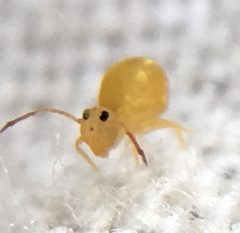
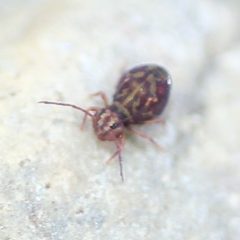
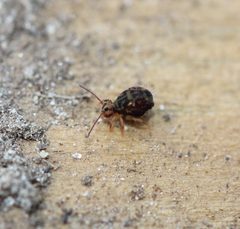
Globular body plan with body length of 1–2 mm and average body mass of 0.743 mg. Possesses a furca (springing organ) that powers jumping. The , a tubular structure, functions in landing and substrate adhesion. Body form is compact and rounded, characteristic of globular springtails (Symphypleona).
Habitat
Terrestrial; inhabits top layers of leaf litter.
Distribution
Documented from the Azores (Faial, Flores, Pico, São Miguel, Santa Maria) and collected from leaf litter in Raleigh, North Carolina, USA. Broader native distribution poorly documented.
Behavior
Furca-powered escape jumps triggered by stimulation. Incapable of directing jumps forward within a 90° heading directly in front when leaving flat surfaces—jumps always involve backwards body . Two landing strategies observed: -anchoring for immediate arrest and recovery, or uncontrolled chaotic tumbling. Furca refolds underneath body during aerial phase.
Ecological Role
Springtails are among the most abundant arthropods globally; specific functions for D. minuta not documented.
Similar Taxa
- Other Dicyrtomina speciesSimilar globular body form and size; require detailed examination of chaetotaxy and color pattern for separation
- Other Symphypleona springtailsShare globular body plan; -level separation requires examination of mouthpart structure and furca
More Details
Jumping Mechanics
Furca-powered jumping system represents a latch-mediated spring-actuated mechanism. Linear performance measures place globular springtail jumps between fleas and froghoppers in acceleration, but angular body rates exceed all other animal systems studied.
Research Significance
D. minuta has been proposed as a promising model for studying extreme rotational dynamics in small jumping arthropods due to its record-breaking spin rates and well-characterized biomechanics.
Sources and further reading
- BugGuide
- Wikipedia
- GBIF taxonomy match
- iNaturalist taxon
- NCBI Taxonomy
- Catalogue of Life
- Tiny raptors: Mantisflies, Mantispidae, and Praying mantises, Mantidae — Bug of the Week
- Bug Eric: Last Night to Blacklight?
- For an Understudied Ant Genus, Two Researchers Choose a "Bird Guide" ID Tool
- Bug Eric: October 2022
- Uncategorized | Blog - Part 12
- Jumping Performance and Behavior of the Globular Springtail Dicyrtomina minuta
- The genome sequence of the springtail, Dicyrtomina minuta (O.Fabricius, 1783).