
Armadilloniscus coronacapitalis
Menzies, 1950
Crowned Driftclinger
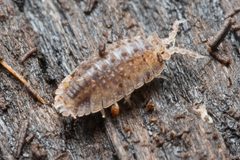
Armadilloniscus coronacapitalis is a terrestrial isopod in the Detonidae, described by Menzies in 1950. It is known from North America, with observations concentrated in coastal and riparian . The species exhibits the typical conglobation (rolling into a ball) characteristic of its . It is one of approximately 20 described species in Armadilloniscus, a genus of small woodlice adapted to moist microhabitats.

Pronunciation
How to pronounce Armadilloniscus coronacapitalis: //ɑːrˌmædɪloʊˈnɪskəs kəˌroʊnəkæpɪˈtælɪs//
These audio files are automatically generated. While they are not always 100% accurate, they are a good starting point.
Identification
Distinguished from other Armadilloniscus by the presence of a characteristic crown-like structure on the (implied by the specific epithet coronacapitalis, from Latin corona 'crown' and capitalis 'of the head'). The species shows the -typical ability to conglobate completely into a ball. Precise diagnostic features require examination of male pleopods and pereiopod .
Images
Habitat
Coastal and riparian environments with high humidity; found in drift material, under stones, and in decaying organic matter in moist microhabitats.
Distribution
North America; documented from coastal regions of the United States, particularly California and the Pacific Northwest based on iNaturalist observation patterns.
Behavior
Exhibits conglobation (voluntary rolling into a complete ball) as a defensive response, a defining trait of the Armadilloniscus.
Ecological Role
Contributes to decomposition of plant material and nutrient cycling in moist terrestrial and semi-terrestrial .
Similar Taxa
- Armadilloniscus spp.Other in the share conglobation and general body form; separation requires detailed examination of cephalic structures and male genitalia.
- Detonidae spp.Related detonid isopods may occupy similar ; Armadilloniscus is distinguished by its complete conglobation ability and specific body proportions.