
Gammarus fasciatus
Say, 1818
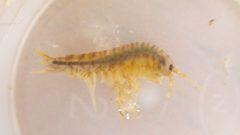
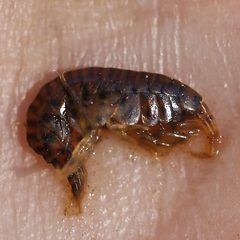
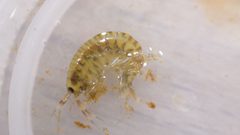
Gammarus fasciatus is a freshwater amphipod native to North America. Laboratory studies demonstrate that food type significantly influences growth rates, with and animal matter supporting greater growth than detritus-based diets. The serves as a for the acephaline gregarine Ganymedes oaklandi. In the Great Lakes region, have declined due to competition with the Ponto-Caspian amphipod Echinogammarus ischnus.
Pronunciation
How to pronounce Gammarus fasciatus: /ˈɡæməˌrʊs fæˈsiaˌtəs/
These audio files are automatically generated. While they are not always 100% accurate, they are a good starting point.
Images
Habitat
Freshwater riverine environments; occurs in large rivers and lakes.
Distribution
Native to North America; documented in southeastern Virginia, the Ohio River, and the Great Lakes region. Records indicate presence in Pennsylvania.
Diet
; consumes filamentous , diatoms, dead animal matter (such as chironomids), coarse particulate organic matter, and fine particulate organic matter. Gut analysis confirms consumption of all these food types in natural . Larger individuals show increased proportional consumption of algae and animal matter.
Host Associations
- Ganymedes oaklandi n. sp. - Acephaline gregarine inhabiting the intestine
Ecological Role
Serves as prey for fish and other aquatic . Contributes to nutrient cycling through consumption of diverse organic matter types. Acts as intermediate for protozoan .
Human Relevance
Used as a bioindicator for trace metal in freshwater systems. Metal burden studies show gut contents significantly influence total body concentrations of Cr, Fe, Mn, and Ni.
Similar Taxa
- Echinogammarus ischnus Ponto-Caspian amphipod that has replaced native G. fasciatus in parts of the Great Lakes through competition.
- Gammarus pseudolimnaeusCo-occurring congeneric in southeastern Virginia with overlapping distribution.
More Details
Conservation concern
The pressure from amphipods in parts of its range, particularly in the Great Lakes where Echinogammarus ischnus has displaced native populations.
Sources and further reading
- BugGuide
- GBIF taxonomy match
- iNaturalist taxon
- NCBI Taxonomy
- Catalogue of Life
- What do insects do in winter? Migrants in the DMV: Common Buckeye, Junonia coenia, Variegated Fritillary, Euptoieta Claudia, Painted Lady, Vanessa cardui, Large Milkweed bug, Oncopeltus fasciatus — Bug of the Week
- Bugs in Orange and Black II: Large milkweed bug, Oncopeltus fasciatus — Bug of the Week
- Orange and Black II: Milkweed leaf beetle, Labidomera clivicollis; Oleander aphid, Aphis nerii; Milkweed Bug, Oncopeltus fasciatus; Monarch, Danaus plexippus — Bug of the Week
- Bugs in orange and black - Monarch butterfly, Danaus plexippus Milkweed Bug - Oncopeltus fasciatus; Milkweed tiger moth, Euchaetes egle — Bug of the Week
- Orange and Black Bugs- Milkweed leaf beetle, Labidomera clivicollis; Oleander aphid, Aphis nerii; Milkweed Bug - Oncopeltus fasciatus; Monarch butterfly, Danaus plexippus — Bug of the Week
- Bugs in orange and black: A spooky Halloween trick or treat for predators - Small and large milkweed bugs, 'Lygaeus kalmii' and 'Oncopeltus fasciatus' — Bug of the Week
- Occurrence and Distribution of the Freshwater AmphipodsGammarus pseudolimnaeusandGammarus fasciatusin Southeastern Virginia
- The Life Cycle of Ganymedes oaklandi n. sp., an Acephaline Gregarine of Gammarus fasciatus (Say)*
- Influence of Food Type on the Growth of a Riverine Amphipod,Gammarus fasciatus
- Behavioural responses of invasive (Gmelinoides fasciatus) and native (Gammarus lacustris) amphipods to predators on different bottom substrates
- Distribution of the Ponto-Caspian Amphipod Echinogammarus ischnus in the Great Lakes and Replacement of Native Gammarus fasciatus
- The life cycle of Gmelinoides fasciatus (Stebbing, 1899) and Gammarus lacustris (Sars, 1863) amphipods in the lake Arakhley littoral during the extreme low-water phase of the hydrological cycle
- Effects of Food Type, Habitat, and Fish Predation on the Relative Abundance of Two Amphipod Species, Gammarus fasciatus and Echinogammarus ischnus
- Total metal burdens in the freshwater amphipod Gammarus fasciatus: contribution of various body parts and influence of gut contents