
Menippe
De Haan, 1833
stone crabs
Species Guides
1- Menippe mercenaria(Florida Stone Crab)
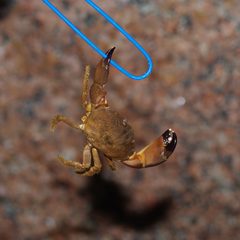
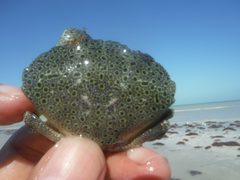
Menippe is a of true crabs in the Menippidae, with most occurring in the Atlantic Ocean. The genus includes commercially important species such as the Florida stone crab (Menippe mercenaria). Species in this genus exhibit physiological adaptations to estuarine environments, including osmoregulatory capacity under varying salinity and temperature conditions. Larvae display diel vertical patterns in the water column.
Pronunciation
How to pronounce Menippe: /məˈnɪpi/
These audio files are automatically generated. While they are not always 100% accurate, they are a good starting point.
Images
Habitat
Marine and estuarine environments. occupy benthic with phenotypic variation related to specific habitat conditions. Larvae are planktonic and found in the water column.
Distribution
Atlantic Ocean; includes native to the Western Atlantic (e.g., Menippe mercenaria, Menippe nodifrons in Brazil).
Life Cycle
Development includes multiple zoeal larval stages. Larval swimming speed increases ontogenetically through zoeal stages.
Behavior
Larvae exhibit diel vertical : swimming upward during daylight hours and downward at night, controlled by and positive . engage in to maintain gill surfaces, with more efficient grooming and lower gill fouling compared to some sympatric crab . Agonistic interactions between conspecifics have been documented.
Human Relevance
Commercially harvested; the Florida stone crab (Menippe mercenaria) supports significant fisheries. Used in comparative physiological studies to assess impacts of climate change and on native .
Similar Taxa
- Charybdis helleriiEcologically similar non-native crab in Brazilian estuaries; Menippe nodifrons shows greater physiological to combined temperature and salinity stress.
- Callinectes sapidusSympatric commercially important crab; Menippe mercenaria exhibits more efficient and lower gill fouling rates.
More Details
Physiological Tolerance
Menippe nodifrons demonstrates greater capacity than the non-native Charybdis hellerii to maintain stable muscle hydration and metabolic function under combined elevated temperature and low salinity conditions.
Sources and further reading
- BugGuide
- Wikipedia
- iNaturalist taxon
- NCBI Taxonomy
- Catalogue of Life
- Agonistic behaviour of the stone crab, Menippe mercenaria (Say)
- Vertical swimming behavior in larvae of the Florida stone crab, Menippe mercenaria
- Grooming behaviors and gill fouling in the commercially important blue crab (Callinectes sapidus) and stone crab (Menippe mercenaria)
- Habitat-related phenotypic variation in adult Western Atlantic stone crabs (Menippe mercenaria Say, 1818) (Decapoda: Brachyura)
- Marine brachyuran crabs’ osmoregulatory and metabolic responses upon warming and seawater dilution challenges: the non-native Charybdis helleri is more sensitive than the native Menippe nodifrons.