
Callinectes ornatus
Ordway, 1863
Ornate Blue Crab
Callinectes ornatus is a small swimming crab in the Portunidae, distinguished from the commercially important Atlantic blue crab (C. sapidus) by having six frontal teeth on the rather than four. It reaches a maximum carapace width of 93 mm, less than half the size of C. sapidus. The inhabits coastal marine environments in the western Atlantic Ocean and Caribbean, with well-studied in southeastern Brazil. It exhibits sexual segregation by depth, with males occupying shallower waters and females found at greater depths. is continuous year-round in subtropical regions, with seasonal peaks varying by location.
Pronunciation
How to pronounce Callinectes ornatus: //ˌkælɪˈnɛktiːz ɔrˈneɪtəs//
These audio files are automatically generated. While they are not always 100% accurate, they are a good starting point.
Identification
Distinguished from Callinectes sapidus by six frontal teeth versus four, smaller maximum size (93 mm vs. 230 mm width), and shorter lateral spines. Carapace coloration and blue claw tips provide additional diagnostic characters. In Brazil, may occur sympatrically with C. danae, from which it differs in reproductive timing and size at maturity.
Images
Appearance
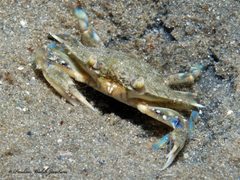
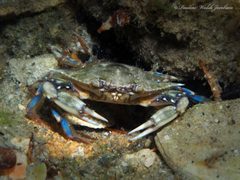
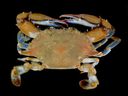
light yellow-brown to red-brown in color. Six frontal teeth on margin of carapace. Lower tips of claws blue. Lateral spines on carapace shorter than those of C. sapidus. Maximum carapace width 93 mm, notably smaller than congeneric C. sapidus. in shape typical of portunid crabs.
Habitat
Coastal marine bays and estuaries. Depth range 5–20 m. individuals and small crabs most abundant in wave-sheltered areas and shallower depths (5–10 m). Males concentrated in shallower transects. Females more abundant at 15–20 m depth. Subtidal with varying exposure levels.
Distribution
Western Atlantic Ocean and Caribbean coastlines. Documented from southeastern Brazil (Ubatuba region, Guanabara Bay, Ubatumirim Bay, Mar Virado Bay, southern Brazil estuary-bay complexes), Amazon Coast (Panaquatira beach). Broader range includes Caribbean and western Atlantic; specific records require verification.
Seasonality
Active year-round in subtropical regions. continuous with variable peaks: summer and possibly spring peaks in Guanabara Bay; highest ovigerous female in January, March, and November in Ubatuba region. Seasonal depth distribution shifts correlated with temperature.
Diet
Small crustaceans and small fish. Scavenging observed. documented in wild individuals, with on smaller, recently molted males.
Life Cycle
Ontogenetic distribution varies by demographic group. and smaller individuals occupy sheltered, shallower ; show sexual segregation by depth. Size at gonadal maturity approximately 67.4 mm width for females. Continuous with year-round presence of ovigerous females in subtropical . Molting cycle and larval development details not specified in available sources.
Behavior
Sexual segregation by depth: males occupy shallower waters, females deeper waters. observed between males, with smaller, recently molted individuals vulnerable to . Temperature-dependent distribution patterns: individuals, females, and ovigerous females positively correlated with bottom and surface temperatures; adult males show opposite trend.
Ecological Role
on small crustaceans and fish; scavenger. may contribute to . Role in benthic structure and trophic dynamics in portunid crab ; specific functions not detailed in sources.
Human Relevance
Not commercially exploited due to small size. Captured as by-catch in pink-shrimp trawling operations in Brazil. No significant direct human use documented.
Similar Taxa
- Callinectes sapidusLarger size (max 230 mm width), four frontal teeth rather than six, longer lateral spines, commercially exploited
- Callinectes danaeSympatric in Brazilian estuaries; differs in size at maturity (79.9 mm vs. 67.4 mm), reproductive peaks in autumn/winter rather than summer/spring, female-biased sex ratio (3.0:1 vs. 1.2:1 male-biased)
More Details
Population structure
Sex ratio male-biased (1.2:1) in Guanabara Bay, contrasting with female-biased ratio in sympatric C. danae. Ovigerous females may migrate to adjacent coastal areas around bays after spawning.
Environmental correlates
Subtropical environmental conditions with moderate seasonal oscillation allow continuous growth and ; temperature is primary factor structuring demographic distribution.
Sources and further reading
- BugGuide
- Wikipedia
- GBIF taxonomy match
- iNaturalist taxon
- NCBI Taxonomy
- Catalogue of Life
- Like Bugs? | Bug Squad
- New NeoBiota special issue explores invasions in aquatic systems
- Trichodes bibalteatus in Oklahoma | Beetles In The Bush
- Bug Eric: My Personal National Moth Week, 2017
- Bug Eric: January 2014
- Ontogenetic distribution of Callinectes ornatus (Decapoda, Portunoidea) in southeastern Brazil
- First record of cannibalism in the blue swimming crab Callinectes ornatus Ordway, 1863 in the wild
- REPRODUCTIVE BIOLOGY AND MOULTING CYCLE OF THE CRAB CALLINECTES ORNATUS (DECAPODA, PORTUNIDAE) FROM THE UBATUBA REGION, SAO PAULO, BRAZIL
- Population biology of Callinectes ornatus Ordway, 1863 (Decapoda, Portunidae) from Ubatuba (SP), Brazil
- Reproductive strategies of two sympatric swimming crabs Callinectes danae and Callinectes ornatus (Crustacea: Portunidae) in an estuarine system, south-eastern Brazil
- Population biology and distribution of the portunid crab Callinectes ornatus (Decapoda: Brachyura) in an estuary-bay complex of southern Brazil