
Achelous spinimanus
(Latreille, 1819)
Blotched Swimming Crab
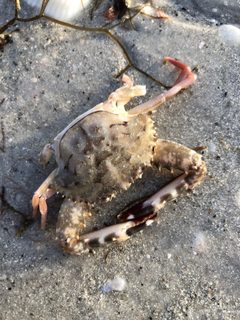
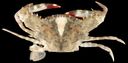
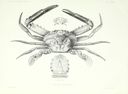
Achelous spinimanus is a swimming crab native to the Western Atlantic, ranging from the USA to Brazil. It inhabits coastal marine environments from shallow waters to 90 m depth, with distinct depth preferences between life stages: juveniles occur at 5–35 m while are most abundant at 25 m and range to 40 m. The exhibits continuous year-round with ovigerous females present in all seasons, and shows seasonal patterns in response to water temperature and salinity changes. It is an emerging fishery resource in Brazil, where it has become a target species following declines in more traditional catches.
Pronunciation
How to pronounce Achelous spinimanus: //ˌækəˈloʊ.əs ˌspaɪnɪˈmænəs//
These audio files are automatically generated. While they are not always 100% accurate, they are a good starting point.
Images
Habitat
Marine coastal benthic environment; depths of 5–90 m. Juveniles occupy shallower depths (5–35 m), while are found at 15–40 m with peak abundance at 25 m. Prefers heterogeneous sediments, particularly gravel, very coarse sand, and intermediate sand. Distribution influenced by sediment texture and protection from fishing activities. During unfavorable conditions (decreased temperature and salinity from South Atlantic Central Water intrusion), migrates to more sheltered areas within bays.
Distribution
Western Atlantic from USA to Brazil. Documented in detail from Ubatuba region, northern coast of São Paulo State, Brazil, specifically in Ubatumirim, Ubatuba, and Mar Virado bays.
Seasonality
Lowest abundance in summer attributed to South Atlantic Central Water intrusion causing decreased temperature and salinity. High abundance in winter and spring. Ovigerous females present year-round indicating continuous , with abundance positively correlated with temperature.
Diet
. First documented record of active on live fish (Malacoctenus zaluari) observed at night, suggesting sit-and-wait predatory strategy using strong chelipeds for capture.
Life Cycle
Nine stages identified from laboratory rearing. Sexual differentiation based on pleopod number apparent from third juvenile stage. First juvenile stage lacks pleopods entirely. Continuous year-round with all gonadal development stages present. Estimated ranges from 188,065 to 682,992 . Ontogenetic depth shift: juveniles occupy shallower depths, migrate deeper.
Behavior
Seasonal to more sheltered bay areas in response to decreased water temperature and salinity. Depth segregation by demographic group, with concentrated at 25 m to avoid competition with other in shallower areas. Reproductive females migrate to deeper areas (10–20 m), possibly as strategy to improve larval and survival. Sit-and-wait strategy suggested by hunting .
Ecological Role
Emerging fishery resource in Brazil, becoming new target due to decline of other profitable species such as shrimp. Suitable for human consumption due to size and taste.
Human Relevance
Targeted for human consumption; considered suitable for fishing due to size and taste. Has become alternative fishing resource as traditional stocks decline.
Sources and further reading
- BugGuide
- GBIF taxonomy match
- iNaturalist taxon
- NCBI Taxonomy
- Catalogue of Life
- Up Close and Personal With Venomous Moths
- First record of preying behaviour of Achelous spinimanus
- Reproductive biology of the swimming crab Achelous spinimanus (Decapoda, Portunoidea): a potential fishing resource
- Environmental factors modulating the bathymetric distribution of the demographic groups of Achelous spinimanus (Crustacea)
- Morphology of juvenile phase of Achelous spinimanus (Latreille, 1819) (Crustacea, Decapoda, Portunidae) reared in laboratory
- Peer Review #3 of "Modulating factors of the abundance and distribution of Achelous spinimanus (Latreille, 1819) (Decapoda, Portunoidea), a fishery resource, in Southeastern Brazil (v0.1)"
- Peer Review #1 of "Modulating factors of the abundance and distribution of Achelous spinimanus (Latreille, 1819) (Decapoda, Portunoidea), a fishery resource, in Southeastern Brazil (v0.1)"
- Peer Review #2 of "Modulating factors of the abundance and distribution of Achelous spinimanus (Latreille, 1819) (Decapoda, Portunoidea), a fishery resource, in Southeastern Brazil (v0.1)"
- Peer Review #2 of "Modulating factors of the abundance and distribution of Achelous spinimanus (Latreille, 1819) (Decapoda, Portunoidea), a fishery resource, in Southeastern Brazil (v0.2)"
- Peer Review #3 of "Modulating factors of the abundance and distribution of Achelous spinimanus (Latreille, 1819) (Decapoda, Portunoidea), a fishery resource, in Southeastern Brazil (v0.2)"
- Reproduction and population structure of Achelous spinimanus (Crustacea: Portunoidea) in the northern coast of São Paulo, Brazil, and influence of environmental factors
- Modulating factors of the abundance and distribution of Achelous spinimanus (Latreille, 1819) (Decapoda, Portunoidea), a fishery resource, in Southeastern Brazil