
Spinicaudata
Linder, 1945
clam shrimp
Family Guides
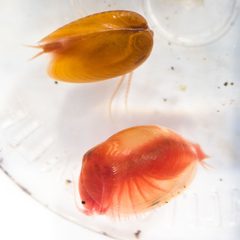
1Spinicaudata is an infraorder of small, bivalved branchiopod crustaceans commonly known as clam shrimp. They inhabit temporary freshwater pools, saline lakes, and rock holes (gnammas) across arid and semi-arid regions worldwide. The group is characterized by a laterally compressed body enclosed within a hinged, clam-like . Many produce drought- resting that persist in dry sediments until favorable conditions return. Reproductive modes vary, with some lineages exhibiting androdioecy ( with occasional males) and others gonochorism (separate sexes with ~1:1 ratios).
Pronunciation
How to pronounce Spinicaudata: /ˌspiː.nɪ.kɔːˈdeɪ.tə/
These audio files are automatically generated. While they are not always 100% accurate, they are a good starting point.
Identification
Spinicaudata are distinguished from other branchiopod groups by their bivalved, hinged that encloses the entire body and appendages, resembling small clams (2–15 mm typically). The carapace shows concentric growth lines. Cercopod —particularly the division pattern of the tail appendages—provides critical characters for distinguishing such as Eulimnadia and Paralimnadia. Eulimnadia possess a spine on the corner of the , while Paralimnadia lacks this spine and shows a cercopod divided midlength by a spine into distinct basal and sections. Resting morphology is highly distinctive and species-specific, often serving as the most reliable identification character where morphological variability is high.
Images
Habitat
Temporary freshwater including ephemeral pools, clay pans, and gnammas (rock holes in granite outcrops). Some occupy saline lakes and wetlands in arid and semi-arid regions. Coastal sandy pools support additional species, though these are vulnerable to urbanization and mining. Occupancy patterns track rainfall and hydroperiod duration; persist through desiccation via resting in dry sediment.
Distribution
Worldwide distribution with documented diversity hotspots in Australia (western New South Wales and Queensland, particularly Paroo/Bulloo catchments; southwest Western Australia; granite outcrop regions), North America (southeastern USA including Georgia and Florida Keys), South America, southern Africa, and India. Fossil representatives known from Jurassic deposits in Patagonia, Argentina, and Devonian-Cretaceous strata globally.
Seasonality
Activity strictly tied to rainfall and hydroperiod availability. emerge rapidly after sufficient rain fills temporary pools, completing within weeks to months before pools dry. Resting remain in dry sediments between wet phases, potentially for years.
Diet
Filter-feeding on suspended organic particles, , bacteria, and detritus; precise dietary composition varies by productivity.
Life Cycle
Development proceeds through naupliar and metanaupliar stages to . Drought- resting (ephippial or desiccation-resistant cysts) with distinctive -specific are produced and deposited in sediments. These eggs enter , surviving prolonged desiccation until rehydration triggers hatching. time is rapid, often completed within the brief hydroperiod of temporary pools.
Behavior
Swimming occurs via metachronal beating of trunk appendages, with the gaping to allow water flow. Males of gonochoristic amplex females on the body margin, maintaining body alignment during mating. Some species exhibit androdioecious with predominant and males rare or absent.
Ecological Role
Primary consumer and in temporary aquatic ; contributes to nutrient cycling and serves as prey for larger and vertebrates in ephemeral pool . Component of metacommunities in gnammas and desert temporary pools, representing significant branchiopod diversity in Australian arid zone wetlands.
Human Relevance
Indicator organisms for temporary wetland health and hydroperiod dynamics. Some threatened by loss from urbanization, mining, and altered hydrology in coastal and arid regions. Resting provides characters for identification in ecological monitoring and biogeographic studies.
Similar Taxa
- LaevicaudataAnother infraorder of clam shrimp; distinguished by and growth line patterns, with Spinicaudata typically showing more pronounced concentric ornamentation and different hinge structure.
- CyclestheridaClosely related clam shrimp group with reduced hinge and distinct reproductive mode involving parthenogenetic cycling; Spinicaudata possess fully developed bivalved carapace with functional hinge.
- OstracodaBivalved crustaceans convergent in body plan but belonging to Maxillopoda; distinguished by fewer appendages, lack of trunk limbs used for filter feeding, and not enclosing and entire body.
More Details
Fossil record
Spinicaudata has an extensive fossil record dating to the Devonian, with the Euestheria particularly well represented in Devonian-Cretaceous deposits globally. Jurassic fossils from Patagonia document ancient diversity in Gondwanan .
Reproductive system diversity
The infraorder encompasses contrasting reproductive strategies: Eulimnadia are probable androdioeces with and males rare, while Paralimnadia is gonochoristic with approximately equal sex ratios. This variation has systematic and evolutionary significance.
Conservation concern
Australian in coastal sandy pools rarity or decline due to urbanization and mining pressure, highlighting vulnerability of temporary pool to destruction.
Sources and further reading
- BugGuide
- iNaturalist taxon
- NCBI Taxonomy
- Catalogue of Life
- Hirschmanniella spinicaudata . [Distribution map].
- Swimming behaviour of Cyzicus grubei (Simon, 1866) (Branchiopoda, Spinicaudata)
- A partial revision of the Australian Eulimnadia Packard, 1874 (Branchiopoda: Spinicaudata: Limnadiidae)
- Distribution of species of Anostraca, Notostraca, Spinicaudata, and Laevicaudata in Mexico
- Distribution of species of Anostraca, Notostraca, Spinicaudata, and Laevicaudata in Mexico
- Mating behaviour in Cyzicus grubei (Simon, 1886) (Branchiopoda, Spinicaudata)
- A review of the Australian endemic clam shrimp, Paralimnadia Sars 1896 (Crustacea: Branchiopoda: Spinicaudata)
- The First Record of the Family Fushunograptidae (‘Conchostraca’, Spinicaudata) from the Cañadón Asfalto Formation (Upper Jurassic), Patagonia, Argentina
- A new species of Eulimnadia (Crustacea; Branchiopoda; Diplostraca; Spinicaudata) from North America
- A first comprehensive dataset of the large branchiopods (Branchiopoda, Anostraca, Notostraca, Laevicaudata, Spinicaudata, Cyclestherida) of India.
- A Worldwide Annotated Checklist of Fossil (Devonian-Cretaceous) Species of the Clam Shrimp Genus Euestheria (Branchiopoda: Diplostraca: Spinicaudata).