
Stygnopsidae
Sørensen, 1932
Stygnopsid Harvestmen
Genus Guides
1Stygnopsidae is a small of harvestmen (Opiliones: Laniatores) comprising approximately 40 described across 8 . The family is predominantly Mexican in distribution, with limited extensions into the southern United States and Central America. Members range from 2.5 to 7 mm in body length and exhibit variable coloration from dark brown to black, with cave-dwelling species showing depigmentation. The family name derives from the type genus Stygnopsis, combining Stygnus with Greek opsis ('resembling'). Phylogenetically, Stygnopsidae represents the sister group to the remainder of Gonyleptoidea, indicating a basal position within this major neotropical harvestman radiation.
Pronunciation
How to pronounce Stygnopsidae: //stɪɡˈnɒpsɪˌdeɪ//
These audio files are automatically generated. While they are not always 100% accurate, they are a good starting point.
Identification
Distinguished from other Gonyleptoidea by combination of small body size, Mexican-Central American distribution, and specific genitalic and podonotal armature characteristics. The family can be separated from Stygnidae (the superficially similar group referenced in the etymology) by features of the male genitalia and tarsal claw structure. Cave-dwelling (e.g., Hoplobunus boneti, Troglostygnopsis spp.) are identifiable by reduced or anophthalmia and depigmented, elongated appendages. Generic identification requires examination of male genitalia and specific patterns of scutal armature; the family includes both heavily armored forms (Karos, Stygnopsis) and relatively smooth-bodied (Paramitraceras).
Images
Appearance
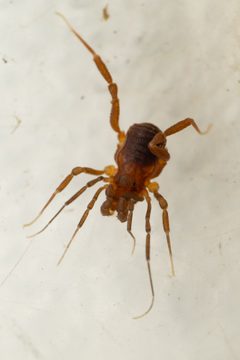
Small-bodied harvestmen with body lengths ranging from 2.5 mm ( Karos) to 7 mm (genus Hoplobunus). coloration ranges from dark brown to black. Appendages are notably lighter in color than the body. Troglomorphic (cave-dwelling) exhibit depigmentation, appearing pale light brown. The is characterized by the typical gonyleptoid body plan with well-developed and armature patterns diagnostic for the group.
Habitat
Primarily terrestrial in mesic to semi-arid environments. Includes surface-dwelling in forested and rocky habitats, as well as troglomorphic species adapted to cave environments. Cave-dwelling species are known from limestone cave systems in Mexico.
Distribution
Almost all occur in Mexico. Hoplobunus extends into the southern United States (Texas). Genus Paramitraceras occurs in Guatemala, El Salvador, and Belize. The shows the narrow geographic ranges typical of Laniatores, with most species restricted to single regions or localities.
Human Relevance
Of minimal direct human significance. Cave-dwelling may serve as indicators of subterranean health. Some species (e.g., Hoplobunus spp.) occur in regions of anthropogenic activity in Texas and northern Mexico.
Similar Taxa
- StygnidaeEtymologically referenced and superficially similar in body form; distinguished by male genitalia and tarsal claw structure
- EpedanidaePotential sister group to Gonyleptoidea sensu lato; distinguished by different geographic distribution (primarily Asian) and genitalic characters
- Other Gonyleptoidea familiesStygnopsidae is sister to all other Gonyleptoidea; distinguished by phylogenetic position and combination of morphological characters including specific patterns of scutal and genital armature
More Details
Taxonomic instability
The Tampiconus was synonymized with Isaeus in 2018, with Tampiconus philippii transferred to Isaeus philippii comb. nov. This indicates ongoing taxonomic revision within the .
Phylogenetic significance
Stygnopsidae holds a critical phylogenetic position as the sister group to all other Gonyleptoidea, making it important for understanding the evolutionary history of this diverse neotropical radiation despite its relatively low .
Troglomorphy
Multiple independent origins of cave-dwelling within the : Hoplobunus boneti, Troglostygnopsis anophthalma, and Troglostygnopsis inops all show troglomorphic adaptations including reduced and depigmentation.