
Chrysso
O. Pickard-Cambridge, 1882
Species Guides
1Chrysso is a of comb-footed spiders (Theridiidae) first described by Octavius Pickard-Cambridge in 1882. The genus currently contains approximately 64 distributed primarily in the Americas and Asia, with some species exhibiting wide geographic ranges. Many species display striking and variable coloration, with some capable of rapid color change when disturbed. The genus has undergone recent taxonomic revision, with several former species transferred to the related genera Megama, Meotipa, and Physcoa.
Pronunciation
How to pronounce Chrysso: /ˈkrɪsoʊ/
These audio files are automatically generated. While they are not always 100% accurate, they are a good starting point.
Identification
True Chrysso are distinguished from related (Megama, Meotipa, Physcoa) by the following combination of characters: opisthosoma longer than wide with extension beyond ; of male palp almost as large as tegular apophysis; embolus arising prolaterally and curving clockwise; sac-like copulatory ducts in females; spherical spermathecae. Distinguished from Megama by the latter's elongated median apophysis with long part, tiny tegular apophysis, shorter embolus with pointed projection, tube-like copulatory ducts, and oval spermathecae. Distinguished from Meotipa by the latter's flattened spines on opisthosoma and legs.
Images
Appearance
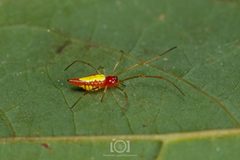
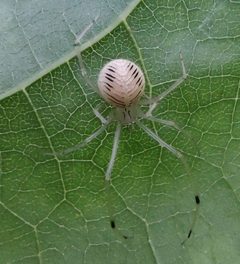
Small to medium-sized theridiid spiders. Females approximately 9 mm in body length. Many exhibit striking coloration that is highly variable within and between . Some species display distinct abdominal patterning, including black sternum and (e.g., C. compressa) or contrasting coloration varying geographically (black in Brazilian populations, yellow in Peruvian populations of some species). Females possess blade-like hairs on the tip of the abdomen. The opisthosoma is longer than wide with a extension beyond the in true Chrysso species.
Habitat
Found on the underside of leaves.
Distribution
Primarily distributed in the Americas and Asia. C. pulcherrima is pantropical. C. nordica occurs in North America and across Asia from Hungary to Mongolia. C. spiniventris has been introduced to Europe. Individual range from USA and Caribbean through Central America to Brazil, Peru, Bolivia, and Argentina in the New World; and from Russia (Far East) through China, Korea, Japan, Taiwan, Philippines, India, and Myanmar in the Old World.
Behavior
Builds star-shaped webs. C. venusta has been observed to rapidly change its color when disturbed.
Similar Taxa
- MegamaFormerly included in Chrysso sensu lato; distinguished by elongated , tiny tegular apophysis, tube-like copulatory ducts, and oval spermathecae.
- MeotipaFormerly included in Chrysso sensu lato; distinguished by flattened spines on opisthosoma and legs.
- PhyscoaFormerly included in Chrysso sensu lato; revalidated as separate with multiple transferred from Chrysso.
More Details
Taxonomic History
The has undergone significant revision. A 2024 revision established new genus Megama and revalidated Physcoa, transferring multiple former Chrysso to these genera as well as to Meotipa.
Color Variability
Coloration is notably variable within . For example, C. compressa shows geographic variation in coloration, with Brazilian specimens having black venters and Peruvian specimens having yellow venters.