
Oecobius annulipes
Lucas, 1846
Ringed Wall Spider
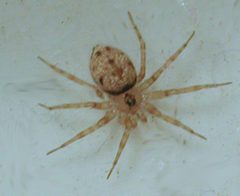
Oecobius annulipes is a small wall-dwelling spider in the Oecobiidae, native to Northern Africa and introduced to Brazil, St. Helena, and Pacific Islands. This has been studied extensively for its -sensitive and web-building . are active primarily from April to early September, with complex strategies that vary based on photoperiod conditions. The species constructs characteristic flat, tangled webs on walls and structures, and has been observed capturing prey through specialized web-use behavior.
Pronunciation
How to pronounce Oecobius annulipes: /iːˈkoʊbiəs əˈnjʊlaɪpiːz/
These audio files are automatically generated. While they are not always 100% accurate, they are a good starting point.
Images
Habitat
Found on walls and vertical surfaces of structures; indoor well-documented. Native range in Northern Africa; introduced populations established in Brazil, St. Helena, and Pacific Islands.
Distribution
Native to Northern Africa. Introduced to Brazil, St. Helena, and Pacific Islands.
Seasonality
appear from April to early September. Females collected April to early September reproduce the same season; females collected after mid-September overwinter and reproduce the following spring.
Life Cycle
Nymphs develop through multiple instars. Under natural and long ( 16:8), nymphs overwinter at the last instar or after attaining adulthood. Under short photoperiod (LD 10:14), instar varies individually but spring timing remains similar. Females produce 1-6 -sacs per lifetime. Excessive overlap occurs in .
Behavior
Constructs flat, tangled webs on walls and vertical surfaces. Web construction and prey capture methods have been observed and described in detail. Mating behavior has been documented. affects nymphal development timing: long photoperiods result in consistent stage, while short photoperiods cause variable overwintering instar but consistent spring timing.
More Details
Phylogenetic relationships
Morphological studies of mouthparts and spinning apparatus show close conformity with Uroctea durandi, suggesting a phylogenetic relationship between Oecobiidae and Urocteidae.
Sources and further reading
- BugGuide
- GBIF taxonomy match
- iNaturalist taxon
- Catalogue of Life
- Encyrtid Holdings | Entomology Research Museum
- Bug Eric: Picture-winged Flies
- Zur biologie und morphologie von Oecobius annulipes lucas (Araneae, Oecobiidae) On the biology and morphology of oecobius annulipes Lucas (Araneae, Oecobiidae)
- Life Cycle of Oecobius annulipes LUCAS (Araneae: Oecobiidae) under Indoor Conditions and the Effect of Photoperiod on Nymphal Development.