
Pardosa tesquorum
(Odenwall, 1901)
thin-legged wolf spider
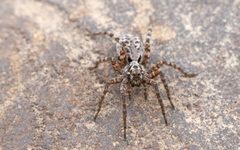
Pardosa tesquorum is a small to medium-sized wolf spider in the Lycosidae, belonging to the Pardosa, commonly known as thin-legged wolf spiders. The has a broad distribution spanning the Palearctic and Nearctic regions, occurring across Russia, Mongolia, China, the United States, and Canada. Like other members of its genus, it is characterized by long, slender legs with distinctive perpendicular spines. Specific ecological details for this species are limited in published literature.
Pronunciation
How to pronounce Pardosa tesquorum: /pɑrˈdoʊsə ˈtɛskwɔrʌm/
These audio files are automatically generated. While they are not always 100% accurate, they are a good starting point.
Identification
Distinguished from other wolf spider by the perpendicular orientation of leg spines, best observed on the long hind legs. Separated from other Pardosa by microscopic characters: females possess a paired genital opening () with species-specific structure, while males have modified resembling small boxing gloves near the that act as a 'key' fitting the female 'lock'. Macroscopic features alone are insufficient for definitive species identification within Pardosa.
Images
Appearance
As a member of Pardosa, this has long spines on the legs that are oriented nearly perpendicular to the leg axis, in contrast to other wolf spiders where spines are shorter and more parallel to the leg surface. The hind pair of legs is notably long, making the perpendicular spines particularly visible there. Body length as an is likely in the 3-12 mm range typical for the genus. The is relatively high with nearly vertical sides of the . may occur, with mature males potentially showing different color patterns from females.
Habitat
Specific preferences for P. tesquorum are not documented. Members of Pardosa occupy diverse habitats including rocky streambeds, marshy wetlands, lake beaches, forest floors, leaf litter, fields, and agricultural edges. Some Pardosa occur at high elevations in mountains. The species name 'tesquorum' (from Latin 'tesqua', meaning rough or wild land) may suggest association with open or uncultivated terrain.
Distribution
Russia (Europe to Kamchatka), Mongolia, China, United States, and Canada. Present in Europe and Northern Asia (excluding China), North America, and Southern Asia.
Similar Taxa
- Other Pardosa speciesAll share the diagnostic perpendicular leg spines; microscopic genital examination required for separation
- Other Lycosidae genera (e.g., Alopecosa, Schizocosa, Tigrosa)Have shorter leg spines oriented more parallel to leg surface; shape differs
More Details
Taxonomic note
The specific epithet 'tesquorum' is derived from Latin 'tesqua' meaning rough or wild land, possibly indicating preference. The was originally described as Lycosa tesquorum by Odenwall in 1901 before transfer to Pardosa.
Data limitations
Most published information on Pardosa refers to the as a whole or to common North American and European . P. tesquorum is among the less-studied members of the genus, with only 5 observations recorded on iNaturalist as of the knowledge cutoff.