
Allocosa
Banks, 1900
Species Guides
8Allocosa is a of wolf spiders ( Lycosidae) comprising over 130 described with a distribution centered in the Americas. The genus was established by Nathan Banks in 1900 and has been the subject of taxonomic revision, with African species assignments remaining uncertain and requiring re-examination. Several well-studied species, including Allocosa brasiliensis, A. alticeps, and A. senex, exhibit notable sex-role reversal in mating systems, where females actively seek male burrows and initiate courtship. These spiders are ground-dwelling burrowers, often inhabiting sandy coastal or dune environments.
Pronunciation
How to pronounce Allocosa: //ˌæ.loʊˈkoʊ.sə//
These audio files are automatically generated. While they are not always 100% accurate, they are a good starting point.
Identification
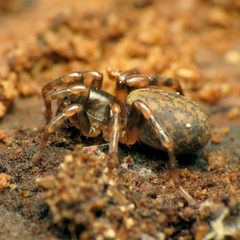
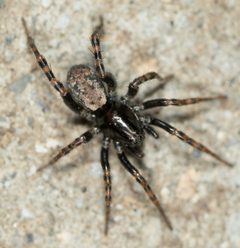
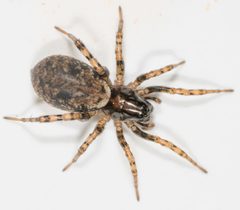
Allocosa are distinguished from other Lycosidae by the combination of: pale and submarginal bands on with restricted setal distribution; median on a small prominence; notched on legs; and ovoid with characteristic patterning of dull yellow with black spots or reticulation. Male Allocosa possess a bifid median of the palp, a key diagnostic character identified in North and Central American species, though this trait has not been confirmed in African specimens historically assigned to the . The genus may be confused with other allocosine wolf spiders, but the specific eye arrangement and abdominal setal cluster are useful distinguishing features.
Images
Appearance
typically bears a pale band and pale submarginal bands, sometimes dark; setae usually restricted to area and mid- line. Carapace convex at lateral margins and narrowed at level of legs I when viewed from above. eye row slightly procurved, equal in length to middle row or somewhat shorter; anterior median eyes larger than anterior laterals and slightly closer to anterior laterals than to each other, positioned on small prominence. Sternum yellow, orange, brown, or black. with 2 or 3 promarginal and 3 retromarginal teeth. Legs usually dark orange or red-brown with notched . ovoid; dorsum dull yellow with fine to dense black spots or reticulation; venter dull yellow or orange, sometimes with small black spots or paired longitudinal dark bands. Anterior abdomen with cluster of dark, curved, erect setae.
Habitat
Ground-dwelling burrowers in sandy substrates, including coastal dunes and sand dunes. Some construct burrows of varying depth depending on sex and reproductive role.
Distribution
Primarily distributed in the Americas (North, Central, and South America), with center of diversity in the New World. Colombian distribution confirmed. Historical records from Africa exist but remain taxonomically uncertain; these African assignments require re-examination and their true generic placement is unresolved.
Host Associations
- Anoplius bicinctus - Pompilid of Allocosa brasiliensis
Behavior
Free-running ground dwellers. surface activity observed in some . in burrowing : females construct simple daytime while males construct deep burrows. In sex-role reversed species, females locate male burrows and initiate courtship. Males donate burrows to females after copulation in some species. Males emit volatile that trigger female courtship behavior, reversing typical spider pheromone roles. Digging behavior in males has been linked to immune function. Behavioral responses to flooding events documented.
Similar Taxa
- Other Lycosidae generaAllocosa shares -level characteristics with other wolf spiders; distinguished by specific arrangement, banding pattern, notched , and male palpal (bifid )
- African species historically assigned to AllocosaTaxonomic uncertainty; these lack confirmed bifid and may represent misassignments requiring re-examination
More Details
Taxonomic Uncertainty
The Allocosa was historically considered to have worldwide distribution based on Roewer's 1959 classification, which included numerous African . However, Dondale and Redner's 1983 revision of North and Central American Allocosa identified the bifid of the male palp as a key diagnostic character. Russell-Smith has noted this character is absent in thousands of examined African lycosids, suggesting the genus may be confined to the Americas. The true placement of African species assigned to Allocosa by Roewer remains unresolved and requires comprehensive re-examination.
Sex-Role Reversal
Multiple Allocosa (A. brasiliensis, A. alticeps, A. senex, A. marindia) exhibit sex-role reversal, a rare phenomenon in spiders where females actively seek males, initiate courtship, and males may invest heavily in mate attraction through production and burrow construction. This system has made Allocosa a model for studying and sex role evolution in arachnids.
Sources and further reading
- BugGuide
- Wikipedia
- GBIF taxonomy match
- iNaturalist taxon
- NCBI Taxonomy
- Catalogue of Life
- Behavioural evidence of male volatile pheromones in the sex-role reversed wolf spiders Allocosa brasiliensis and Allocosa alticeps
- Nocturnal Surface Activity and Behavioural Responses to Floods inAllocosa senex(Araneae: Lycosidae)
- Sex and burrowing behavior and their implications with lytic activity in the sand-dwelling spider Allocosa senex
- Reproductive isolation and sex-role reversal in two sympatric sand-dwelling wolf spiders of the genus Allocosa
- Description of the female of <i>Allocosa yurae</i> (Strand, 1908) (Araneae: Lycosidae, Allocosinae)
- Spider hawk in sand dunes: Anoplius bicinctus (Hymenoptera: Pompilidae), a parasitoid wasp of the sex-role reversed spider Allocosa brasiliensis (Araneae: Lycosidae)
- Habitat Preference and Effects of Coastal Fragmentation in the Sand-Dwelling Spider <i>Allocosa brasiliensis</i> (Lycosidae, Allocosinae)
- Spatial distribution, burrow depth and temperature: implications for the sexual strategies in twoAllocosawolf spiders
- Tell Me How Much DNA You Have and I'll Tell You What Your Sex Is: Sex Determination by Flow Cytometry of Spiderlings of Allocosa marindia