
Mermessus
O. Pickard-Cambridge, 1899
Decorated-fanged Linyphiids
Species Guides
8- Mermessus albulus
- Mermessus bryantae(dwarf spider)
- Mermessus fradeorum
- Mermessus index
- Mermessus maculatus(dwarf spider)
- Mermessus tridentatus(dwarf spider)
- Mermessus trilobatus(Trilobate Dwarf Weaver)
- Mermessus undulatus(Dancing Dwarf Weaver)
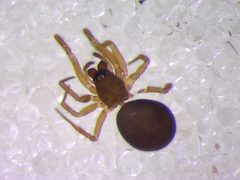
Mermessus is a of dwarf spiders ( Linyphiidae) comprising approximately 82 as of 2025. The genus is notable for including Mermessus trilobatus, one of Europe's most spider species, which has spread across the continent from North America since the late 1970s. Research on Mermessus fradeorum has established it as an emerging model system for studying heritable bacterial , as individuals can up to five simultaneous symbionts including Rickettsiella, , and Tisiphia. Some species exhibit low specificity, contributing to their invasion success in agricultural and semi-natural .
Pronunciation
How to pronounce Mermessus: //mɛrˈmɛsəs//
These audio files are automatically generated. While they are not always 100% accurate, they are a good starting point.
Images
Habitat
within this occupy diverse open , particularly agricultural landscapes and grasslands. Mermessus trilobatus occurs in hay meadows and grasslands with regular vegetation disturbance (mowing or grazing), but is rarely found in forests (2.4% of records) or highly disturbed crops with cultivated soil (1.3% of records). In Belgium, M. trilobatus demonstrated the highest habitat diversity among 150 captured spider species in an old sand quarry, occurring in every pitfall trap across 25 locations. Activity- has been linked to soil pH and temperature.
Distribution
Native to North America; established in Europe since the late 1970s. Mermessus trilobatus was first detected near Karlsruhe, Germany, and has since undergone concentric range expansion across Austria, Belgium, Croatia, Czech Republic, France, Great Britain, Hungary, Italy, Netherlands, Poland, Slovakia, Slovenia, Switzerland, and Ukraine. GBIF records also indicate presence in Denmark, Norway, Sweden, and Vermont (USA).
Seasonality
of M. trilobatus most commonly observed in summer (June-July).
Behavior
Mermessus trilobatus builds horizontal sheet webs for prey capture and is an obligatory web-builder. Web-building provides protection against . The shows high mobility and is easily transported via human activity. Contrary to expectations for , M. trilobatus exhibits poor competitive ability due to smaller body size relative to native sympatric spiders.
Ecological Role
Mermessus trilobatus can achieve high abundance in agricultural grasslands, becoming among the most abundant spider in these . Its potential as a biocontrol agent has been suggested due to its predatory role. However, its status in European semi-natural raises concerns about ecological impacts.
Human Relevance
Mermessus trilobatus is considered the most spider in Europe, representing one of few invasive spider successfully colonizing semi-natural rather than being restricted to human buildings. Research on M. fradeorum has advanced understanding of - interactions, with potential applications for pest control through mechanisms. M. trilobatus shows unexpected sensitivity to soil tillage, with experimental disturbance reducing densities by approximately 90%, which has implications for agricultural management.
Similar Taxa
- Oedothorax apicatusNative European linyphiid spider that increases in abundance following superficial soil tillage, showing opposite response to disturbance compared to M. trilobatus
More Details
Symbiont Research Model
Mermessus fradeorum has been developed as a model system for studying heritable . Individual spiders can simultaneously five bacterial symbionts: Rickettsiella (a recently described symbiont common in ticks), three strains of , and Tisiphia. When all five symbionts are present, hosts undergo feminization where genetic males develop as functional females capable of spreading symbionts. This feminization appears to require cooperation among multiple symbionts, as Tisiphia alone cannot induce the phenotype.
Invasion Biology Paradox
The invasion success of M. trilobatus presents an ecological paradox: despite being highly across Europe, the shows low to soil disturbance and poor competitive ability against native spiders. This contradicts typical strategies and suggests alternative mechanisms such as enemy release or reduced sensitivity may explain its success.
Sources and further reading
- BugGuide
- Wikipedia
- GBIF taxonomy match
- iNaturalist taxon
- NCBI Taxonomy
- Catalogue of Life
- How an Entomologist Explores the Bacterial Saboteurs of Insect Reproduction
- Low habitat specificity in one of Europe’s most invasive spiders – Mermessus trilobatus
- Unexpected sensitivity of the highly invasive spider Mermessus trilobatus to soil disturbance in grasslands