
Erigone dentosa
O. Pickard-Cambridge, 1894
Hook-toothed Money Spider
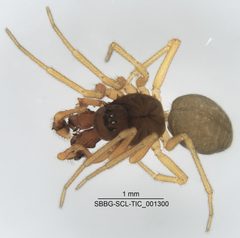
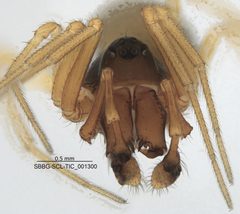
Erigone dentosa is a dwarf spider in the Linyphiidae, commonly known as money spiders. The is native to North and Central America, with a documented range from the United States through Mexico to Guatemala. It has been introduced to Europe, with established recorded in Belgium. The specific epithet 'dentosa' refers to toothed structures, likely describing features of the genitalia used in species identification.
Pronunciation
How to pronounce Erigone dentosa: //ˈɛrɪɡoʊniː dɛnˈtoʊsə//
These audio files are automatically generated. While they are not always 100% accurate, they are a good starting point.
Identification
Identification relies on microscopic examination of genital structures. The name 'dentosa' (toothed) suggests distinctive tooth-like projections on the epigyne (female) or (male), though specific diagnostic features require arachnological reference. As with most Erigone species, external somatic characters are insufficient for reliable identification.
Images
Distribution
Native range: United States, Mexico, Guatemala, and Canada. Introduced range: Belgium (Europe). The has been documented across a broad latitudinal gradient in North America, from temperate to tropical zones.
Ecological Role
As a linyphiid spider, it likely functions as a of small in ground and vegetation layers, contributing to regulation.
Similar Taxa
- Erigone spp.Other Erigone are morphologically similar and require genitalic examination for separation; E. dentosa is distinguished by its specific tooth-like structures implied by the species name.
More Details
Nomenclature
Described by O. Pickard-Cambridge in 1894. The specific epithet 'dentosa' is Latin for 'toothed' or 'having teeth', a common descriptive term in spider referring to sclerotized structures in the reproductive organs.
Introduction to Europe
The Belgian introduction represents a known case of transatlantic spider , likely through human commerce or transport. The establishment of North American linyphiids in Europe is documented but not fully studied in terms of ecological impact.