
Argiope florida
Chamberlin & Ivie, 1944
Florida argiope, Florida garden spider
Argiope florida is a of orb-weaving spider in the Araneidae, restricted to the southeastern United States. Like other Argiope species, it constructs spiral orb webs with a conspicuous silk decoration called a . Research on this species has focused on the function of these web decorations and their influence on spider , including fleeing responses and anti- strategies.
Pronunciation
How to pronounce Argiope florida: /ˈɑrɡiˌoʊpi ˈflɔrɪdə/
These audio files are automatically generated. While they are not always 100% accurate, they are a good starting point.
Identification
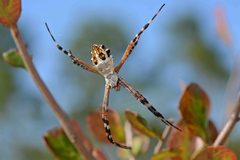
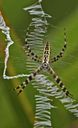
Distinguished from other North American Argiope by its restricted southeastern U.S. distribution. Argiope aurantia (black and yellow garden spider) has a zigzag and more broadly oval . Argiope trifasciata (banded garden spider) has transversely striped abdomen and spotted, annulated legs. Argiope argentata (silver argiope) occurs in southern Florida to California and typically displays an X-shaped stabilimentum. Definitive identification of A. florida requires examination of morphological details not summarized in general sources.
Images
Appearance
As an Argiope , possesses the characteristic large body size and bold abdominal patterning typical of the . Specific coloration and pattern details for A. florida are not well documented in available sources, though typically display contrasting black, yellow, silver, or banded abdominal markings. Females are substantially larger than males, a pattern consistent across the genus.
Habitat
Restricted to specific areas in the southeastern United States. Web-building that constructs orb webs in vegetation, with web height from ground influencing spider according to research findings.
Distribution
to the United States, with range restricted to the southeastern region. Not found throughout the entire country despite initial broader distributional statements; confirmed occurrences are limited to specific areas in the southeast.
Seasonality
Activity period not explicitly documented in available sources. Based on patterns, likely active during warmer months with mature most visible in late summer and early autumn.
Diet
Feeds on insects captured in its orb web. Specific prey types documented for this are not detailed in available sources.
Life Cycle
Detailed information not available for this . As an orb-weaving spider, likely follows general araneid pattern: deposited in protective silk sacs, spiderlings hatch and may undergo before emerging, with or potentially multi-year life cycle depending on climate.
Behavior
Constructs orb webs with silk decorations (). Research demonstrates that web height from ground influences fleeing , with spiders in more exposed positions showing modified anti- responses. Studies specifically examining this found no influence of silk decoration extent on fleeing behavior or initiation distance when approached by simulated predators or looming objects, though the presence of decorations has been hypothesized to reduce costly escape responses. Web orientation and stabilimentum structure have been subjects of dedicated study.
Ecological Role
of flying insects; contributes to local dynamics through web-building and potential intraguild interactions. Specific role studies not documented.
Human Relevance
Not considered dangerous to humans. Like other Argiope , may be encountered in gardens and natural areas where its large webs are conspicuous. Subject of scientific research on web decoration function and spider .
Similar Taxa
- Argiope aurantiaOverlaps in eastern U.S.; distinguished by zigzag pattern and more broadly oval shape
- Argiope trifasciataWidespread across U.S.; distinguished by transversely banded and spotted, annulated legs
- Argiope argentataOccurs in southern Florida and west to California; typically constructs X-shaped and has more silvery coloration
More Details
Research significance
Argiope florida has been specifically studied to test hypotheses about function, particularly whether silk decorations serve anti- purposes versus visibility signals to prevent web destruction. Results have contributed to broader understanding of web decoration evolution in orb-weaving spiders.
Taxonomic note
Described by Chamberlin & Ivie in 1944. The epithet 'florida' refers to the state of Florida, within its core range.
Sources and further reading
- BugGuide
- Wikipedia
- GBIF taxonomy match
- iNaturalist taxon
- NCBI Taxonomy
- Catalogue of Life
- Bug Eric: Spider Sunday: Silver Argiope
- Bug Eric: Spinybacked Orbweaver
- Arachnida | Beetles In The Bush | Page 9
- Bug Eric: September 2011
- August | 2012 | Beetles In The Bush | Page 2
- Bug Eric: Spider Sunday: Banded Argiope
- The influence of web silk decorations on fleeing behaviour of Florida orb weaver spiders, Argiope florida (Aranaeidae)
- WEB ORIENTATION, STABILIMENTUM STRUCTURE AND PREDATORY BEHAVIOR OF ARGIOPE FLORIDA CHAMBERLIN & IVIE 1944 (ARANEAE, ARANEIDAE, ARGIOPINAE)