
Parasitina
Infraorder Guides
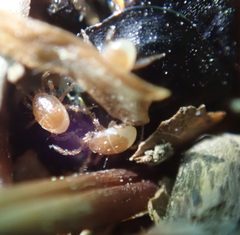
1Parasitina is a suborder of predatory mites within the order Mesostigmata, characterized by relatively large body size for mites and typically yellowish to dark brown coloration. Members are free-living that actively hunt microarthropods and in soil and litter . The suborder includes the Parasitidae, which contains approximately 400 across 29 in two . involves complex cytoskeletal reorganization with distinct roles for F-actin and tubulin in nuclear shaping, acrosome formation, and flagellar development.
Pronunciation
How to pronounce Parasitina: /ˌpærəˈsaɪtɪnə/
These audio files are automatically generated. While they are not always 100% accurate, they are a good starting point.
Images
Habitat
Soil and leaf litter environments; specific microhabitat preferences vary by .
Distribution
Worldwide distribution across multiple continents.
Diet
Predatory; preys on microarthropods and . Individual typically exhibit narrower prey ranges than the group as a whole.
Ecological Role
in soil and litter , contributing to regulation of microarthropod and .