
Rhagidiidae
Oudemans, 1922
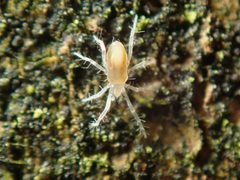
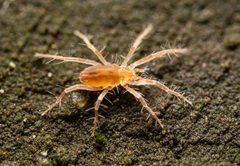
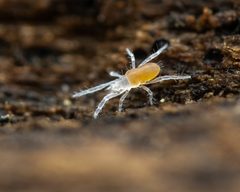
Rhagidiidae is a of soft-bodied, soil mites in the order Trombidiformes. The family comprises approximately 28 and 150 of whitish mites that inhabit soil environments, with many species showing adaptations to subterranean life. Established by Oudemans in 1922, the family received its modern systematic foundation through Zacharda's 1980 world revision. Many species exhibit troglomorphic traits including reduced , elongated appendages, and depigmentation.
Pronunciation
How to pronounce Rhagidiidae: /ræˈdʒɪdiˌaɪdiː/
These audio files are automatically generated. While they are not always 100% accurate, they are a good starting point.
Images
Habitat
Soil environments, with frequent occurrence in caves and other subterranean . Many are troglobitic, showing morphological adaptations to permanent cave life.
Distribution
Widespread in soil ; documented from North American caves, northeastern Prealps of Italy, and NW Lapland. Distribution records from GBIF include Denmark, Norway, and Sweden.
Diet
.
Ecological Role
Soil-dwelling . patterns in NW Lapland have been proposed as potential indicators for monitoring climate warming based on responses to environmental and patterns.
Sources and further reading
- BugGuide
- Wikipedia
- GBIF taxonomy match
- iNaturalist taxon
- NCBI Taxonomy
- Catalogue of Life
- THE ECOLOGY OF RHAGIDIIDAE
- Robustocheles occulta sp.n., a new troglobitic mite (Acari: Prostigmata: Rhagidiidae) from North American caves
- The Rhagidiidae (Acari: Prostigmata) in NW Lapland: Could their assemblages be climate warming monitors related to environmental and habitat patterns?
- A review of the genus Traegaardhia (Acari, Prostigmata, Rhagidiidae) with descriptions of new species and a key to species