
Panonychus ulmi
(Koch, 1836)
European red mite, fruit tree red spider mite, apple red spider mite
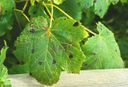
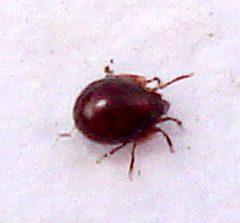
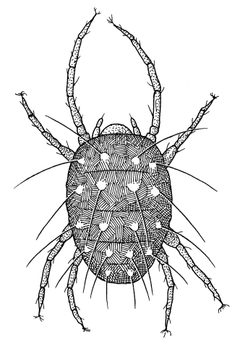
Panonychus ulmi, the , is a major agricultural pest of deciduous fruit trees with global economic significance. The exhibits a high reproductive rate and short time of approximately 21 days at 20°C, enabling multiple per year. It possesses a distribution spanning Europe, Asia, Africa, North America, South America, and Australasia. First described by Carl Ludwig Koch in 1836, this spider mite is particularly damaging to apple orchards and grapevines.
Pronunciation
How to pronounce Panonychus ulmi: //pænəˈnaɪkəs ˈʌlmaɪ//
These audio files are automatically generated. While they are not always 100% accurate, they are a good starting point.
Images
Habitat
Associated with deciduous fruit trees and forest trees; found in apple orchards, grapevines, and other cultivated fruit tree systems. In Brazil, climatically suitable areas occur in the southern region where temperature regimes favor establishment.
Distribution
distribution documented across Europe (including Austria, Belgium, France, Germany, Italy, Netherlands, Spain, UK, and others), Asia (China, India, Iran, Israel, Japan, Korea, Lebanon, Syria, Taiwan), Africa (Algeria, Egypt, Libya, South Africa, Tunisia), North America (Canada, USA), Central America and Caribbean (Bermuda, Rica), South America (Argentina, Brazil, Chile, Uruguay, Venezuela), and Australasia (Australia, New Zealand). Within Brazil, the southern region (Paraná, Rio Grande do Sul, Santa Catarina) is environmentally favorable.
Host Associations
- apple - primary Malus communis; cv. Starking Delicious identified as favorable
- grapevine - Vitis vinifera
- quince - Cydonia oblonga
- sweet cherry - Prunus avium
- sour cherry - Prunus cerasus
Life Cycle
time of approximately 21 days at 20°C under laboratory conditions (25±2°C, 60±10% RH, 16:8 L:D). Multiple produced annually.
Ecological Role
Agricultural pest of global economic importance on deciduous fruit and forest trees
Human Relevance
Major agricultural pest causing damage to fruit tree crops; growth performance studies indicate potential for serious pest status on multiple plants under favorable conditions. Predictive distribution modeling used to identify climatically suitable areas for monitoring and management.
Similar Taxa
- Panonychus citriCongeneric with overlapping distribution in Japan; both are agricultural pests requiring differentiation in regional surveys
More Details
Population biology
Laboratory studies demonstrate highest net reproductive rate, , and finite rate of increase on apple cv. Starking Delicious compared to quince, cherry, and sour cherry. growth parameters vary significantly by plant.
Environmental responses
increases with plant phosphorus content and is optimized at 60-75% relative humidity; most favorable conditions combine high phosphorus with 75% RH at 21-25°C.
Historical taxonomy
Originally described as Tetranychus ulmi by Koch in 1836; later transferred to Panonychus.
Sources and further reading
- BugGuide
- Wikipedia
- GBIF taxonomy match
- iNaturalist taxon
- NCBI Taxonomy
- Catalogue of Life
- Gall darn it! Gall insects on hickory, oak, and elm, Phylloxera caryaecaulis, Andricus palustris, Colopha ulmicola — Bug of the Week
- Botanizing at Salt Lick Point Land & Water Reserve | Beetles In The Bush
- 🌿 Botanizing w/ the Webster Groves Nature Study Society (WGNSS) Botany Group at Rockwoods Reservation – 3 Nov 2025 | Beetles In The Bush
- Uncategorized | Blog - Part 28
- Thelypteridaceae | Beetles In The Bush
- Panonychus ulmi . [Distribution map].
- Panonychus ulmi . [Distribution map].
- Spacial distribution and suitability for Panonychus ulmi (Tetranychidae) in Brazil
- Population growth performance of Panonychus ulmi Koch (Acarina: Tetranychidae) on different fruit trees
- GEOGRAPHICAL DISTRIBUTION OF THE CITRUS RED MITE, PANONYCHUS CITRI AND EUROPEAN RED MITE, P. ULMI IN JAPAN
- EFFECTS OF HUMIDITY AND PHOSPHORUS ON POPULATIONS OF THE EUROPEAN RED MITE PANONYCHUS ULMI (ACARI: TETRANYCHIDAE)1
- Intraleaf Distribution of Panonychus ulmi (KOCH) : (Acarina : Tetranychidae) on Dwarf Bamboo