
Tenuipalpidae
Flat mites, False spider mites
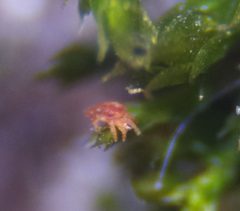
Tenuipalpidae, commonly known as flat mites or false spider mites, are a of phytophagous mites in the order Trombidiformes. They are closely related to spider mites (Tetranychidae) but are distinguished by their dorsoventrally flattened bodies and reduced mobility. Members are typically reddish in color and slow-moving. Several are significant agricultural pests, including Raoiella indica, Brevipalpus phoenicis, B. californicus, B. obovatus, and B. lewisi.
Pronunciation
How to pronounce Tenuipalpidae: /ˌtɛnjuˌɪˈpælpɪdiː/
These audio files are automatically generated. While they are not always 100% accurate, they are a good starting point.
Identification
Distinguished from Tetranychidae (true spider mites) by dorsoventrally flattened body and slower movement. Identification to and level requires examination of leg setation patterns and ontogeny; keys are available for regional faunas including Greece and Australia.
Images
Habitat
Primarily associated with vascular plants; found on tender shoots and leaves, particularly near leaf midribs or on the undersides of leaves. Some show specificity to particular plant such as Casuarinaceae.
Distribution
distribution with records from Europe (Greece, Scandinavia), North America, Australia, and other regions. Specific distribution varies by and .
Diet
Phytophagous; feeds on plant tissues, typically near leaf midribs or on the undersides of leaves. Specific dietary details beyond plant-feeding are not well documented at the level.
Host Associations
- Olea europaea - Multiple including Hystripalpus and Brevipalpus
- Casuarinaceae - She-oak; -specific associations documented for multiple
- Phalaenopsis - Greenhouse orchids; of Tenuipalpus pacificus
Life Cycle
Development includes , larva, deutonymph, and stages. Specific duration and reproductive details vary by and are not well characterized at the level.
Behavior
Slow-moving compared to Tetranychidae. Some exhibit -specificity. Multiple species may co-occur on a single host plant species.
Ecological Role
Herbivores on vascular plants; some are significant agricultural pests.
Human Relevance
Several are important crop pests causing economic damage to cultivated plants including olive, citrus, and greenhouse orchids. Species of concern include Raoiella indica, Brevipalpus phoenicis, B. californicus, B. obovatus, and B. lewisi. Subject to biosecurity interceptions and cross-border movement monitoring.
Similar Taxa
- TetranychidaeTrue spider mites; distinguished by more rounded body shape and faster movement
More Details
Taxonomic diversity
The includes multiple with high ; recent revisions have described numerous new , particularly from Australia and Greece. Tegopalpinae has been identified as monophyletic with sister group Phytoptipalpus.
Research gaps
Leg setation and ontogeny have been reviewed for some but remain incompletely characterized across the . Mating has been preliminarily studied in Raoiella indica with evidence of putative odor-mediated interactions.
Sources and further reading
- BugGuide
- Wikipedia
- GBIF taxonomy match
- iNaturalist taxon
- NCBI Taxonomy
- Catalogue of Life
- Tenuipalpidae (Acari: Trombidiformes) from Casuarinaceae (Fagales)
- The genus Brevipalpus in Greece (Acari: Tenuipalpidae)
- Α new species of Hystripαlpus (Acari: Tenuipalpidae)
- The genus Tenuipalpus (Acari: Tenuipalpidae) in Greece
- Α revision of tenuipalpid mites of Greece (Acari: Tenuipalpidae)
- Phalaenopsis Mite, Tenuipalpus pacificus Baker (Arachnida: Acari: Tenuipalpidae)
- False Spider Mite, Brevipalpus californicus (Banks) (Archnida: Acari: Tenuipalpidae)
- Α revision of the genus Cenopalpus in Greece (Acari: Tenuipalpidae)
- Tiny Trouble, Unknown Risk: International Interceptions Highlight Cross-Border Movement and Biosecurity Threat of Cenopalpus (Acari: Tenuipalpidae).
- Mating behavior and preliminary evidence of putative odor-mediated interactions in Raoiella indica (Acari: Tenuipalpidae).