
Nanorchestidae
Grandjean, 1937
Genus Guides
1Nanorchestidae is a of small soil-dwelling mites in the order Endeostigmata. The family contains two recognized , Nanorchestes and Speleorchestes, which show distinct ecological partitioning: Nanorchestes dominates cold desert and polar , while Speleorchestes inhabits hot deserts. This distribution correlates with structural differences in the . Members of this family may achieve high numerical abundance in extreme desert soils.
Pronunciation
How to pronounce Nanorchestidae: /ˌnænɔrˈkɛstɪdiː/
These audio files are automatically generated. While they are not always 100% accurate, they are a good starting point.
Identification
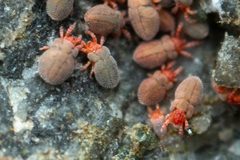
Nanorchestes possess regularly spaced cuticular granulations absent in Speleorchestes; these granulations are visible under magnification and create a textured body surface. Nanorchestes antarcticus reaches approximately 0.25 mm in length.
Images
Habitat
Soil-dwelling; occupies both hot and cold deserts worldwide. Nanorchestes are associated with seasonally waterlogged polar soils and glacier margins. Speleorchestes species occur in hot desert environments.
Distribution
. Documented from Denmark, Norway, and Sweden; also occurs in Antarctica (Nanorchestes antarcticus) and hot deserts (Speleorchestes).
Behavior
Nanorchestes retain a layer of air over the body via cuticular granulations, which has been observed to facilitate cuticular respiration in waterlogged polar soils and reduce freezing through direct contact with ice.
Ecological Role
May numerically dominate soil faunas in extreme desert environments, both hot and cold.
Similar Taxa
- Other Endeostigmata familiesNanorchestidae can be distinguished by the combination of soil-dwelling habit in extreme deserts and, in Nanorchestes, the presence of cuticular granulations; most other endeostigmatan lack these specific structural and ecological traits.
More Details
Cuticular Adaptation
The granulated of Nanorchestes represents a structural to polar conditions, contrasting with the smooth cuticle of Speleorchestes in hot deserts. This is one of the few documented examples of cuticular directly linked to thermal partitioning within a mite .