
Lachesillidae
Pearman, 1936
Fateful Barklice
Genus Guides
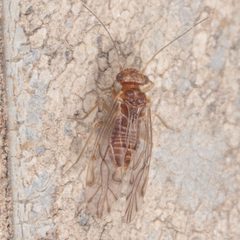
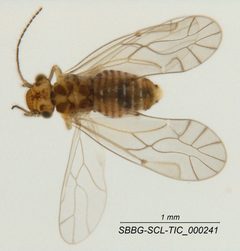
2is a of barklice within the order Psocodea (formerly ), suborder Psocomorpha. The family contains more than 400 across 26 , with the majority belonging to the genus Lachesilla. Members are characterized by distinctive wing venation featuring a rounded, free areola postica, and males exhibit diverse sclerotized genitalic structures.
Pronunciation
How to pronounce Lachesillidae: /ˌlætʃɪˈsɪlɪdiː/
These audio files are automatically generated. While they are not always 100% accurate, they are a good starting point.
Identification
The rounded, free areola postica in the wings is the primary diagnostic feature distinguishing from other psocopteran . Male genitalic structures, particularly the number and form of clunial , are critical for -level identification within the family. The Waoraniella, for example, was historically restricted to the Amazon Basin but has been found in Andean regions at 1000–2000 m elevation.
Images
Appearance
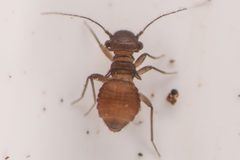
Small, soft-bodied insects with wings that possess a rounded, free areola postica—a distinct in the wing venation that is not connected to other at its margin. Males display highly variable sclerotized genitalic structures that serve as important taxonomic characters for identification.
Habitat
Found in diverse environments including tropical and subtropical forests. Some , such as Waoraniella, occur in Andean montane regions between 1000–2000 m elevation, while others are distributed in lowland Amazonian . Specific microhabitat preferences within these regions are not well documented.
Distribution
Widely distributed in the Neotropics with records from Colombia (including the Amazonian Department of Putumayo and the Andean Valle del Cauca), Rica, Brazil (North and Northeast regions), and Arizona (USA). The Waoraniella was historically known only from the Amazon Basin but has been documented in the Andean region of Colombia.
Human Relevance
No direct economic or medical significance has been documented. The is primarily of scientific interest for taxonomic and biodiversity studies.
Similar Taxa
- Other Psocomorpha families is distinguished from related by the rounded, free areola postica in the wings; other families typically have the areola postica connected to surrounding or differently shaped.
More Details
Taxonomic diversity
The comprises 26 and more than 400 , making it one of the more species-rich families within Psocomorpha. The genus Lachesilla alone contains the majority of these species.
Research focus
Recent taxonomic work has focused on the pedicularia group within Lachesilla, utilizing male clunial as a key diagnostic character for species identification.
Sources and further reading
- BugGuide
- Wikipedia
- GBIF taxonomy match
- iNaturalist taxon
- NCBI Taxonomy
- Catalogue of Life
- New species of Lachesilla Westwood in the pedicularia group (Psocodea: 'Psocoptera’: Lachesillidae) from the Colombian Amazonia
- The genus Waoraniella García Aldrete (Lachesillidae: Eolachesillinae: Waoraniellini) in Colombia: Two new species from the Andean region