
Heliodinidae
Heinemann & Wocke, 1876
Sun Moths
Genus Guides
5, commonly known as , is a of small, brightly colored day-flying with slender bodies and narrow wings. The family has a worldwide distribution and is characterized by distinctive morphological features including a bare haustellum base and compact that appear shield-like. Many exhibit a characteristic resting posture with raised hindlegs, though this is not universal across all .
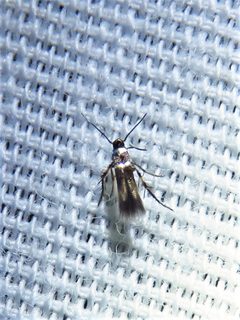
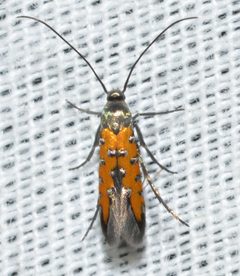
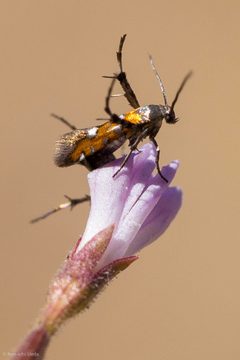
Pronunciation
How to pronounce Heliodinidae: /ˌhiːlioʊˈdaɪnɪdiː/
These audio files are automatically generated. While they are not always 100% accurate, they are a good starting point.
Identification
Small with slender bodies and narrow wings. The base of the haustellum is bare (unscaled). are compact and shield-like in appearance. Many have the inner and outer spurs of the metatibia subequal in length. Some exhibit a resting posture with raised hindlegs, though this is absent in Epicroesa and Lamprolophus.
Images
Distribution
Worldwide distribution; found on all continents.
Diet
Larvae feed primarily on plants in the order Caryophyllales, with records in Aizoaceae, Chenopodiaceae, Phytolaccaceae, Portulacaceae, and Nyctaginaceae. A few feed on Onagraceae, Araliaceae, and Piperaceae.
Life Cycle
Larvae employ diverse feeding strategies including skeletonizing leaves, boring into leaf stems, leaf mining, and opportunistically invading cecidomyiid galls. Pupae have long stiff hairs on their surface.
Behavior
Many raise their hindlegs when resting, though this is not a universal trait across all . Day-flying activity pattern.