
Dictyopharidae
Spinola, 1839
Dictyopharid Planthoppers
Subfamily Guides
2is a of planthoppers in the infraorder Fulgoromorpha, comprising nearly 760 in more than 150 . The family is characterized by distinctive morphological features including an elongated or projection in many species, and arising from the side of the head below the . The family is divided into two : Dictyopharinae and Orgeriinae. Fossil records extend back to the Late Cretaceous (Santonian age).


Pronunciation
How to pronounce Dictyopharidae: //ˌdɪktioʊˈfærɪdiː//
These audio files are automatically generated. While they are not always 100% accurate, they are a good starting point.
Identification
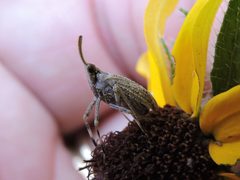
Members of can be distinguished from related fulgoroid by the following features: arising on the side of the below the (not between the as in Cicadoidea); ocellus absent; many possess an elongated (head projection); those without elongation typically have 2-3 carinae (keels) on the frons. The Scolops, found in North America, is particularly distinctive with its squat body and pronounced elongated 'nose' or frons extension, resembling a rhinoceros.
Images
Habitat
vary by and region. The North American genus Scolops is most common in arid habitats including dry fields, prairies, and grasslands. Australian Cleotychini occur in specific national park localities including Cania Gorge, Eurimbula, and Blackdown Tableland. The new genus Femotyche from Western Australia was collected from Perth area and York. Many species occupy general grassland and open vegetation habitats.
Distribution
The has a global distribution with particular diversity in tropical and subtropical regions. The Scolops is restricted to southern Canada, the United States, and northern Mexico. Australian representatives include Cleotychini with in Queensland and Western Australia. The genus Anasta occurs in North Australia, Papua New Guinea, Timor (Indonesia), and Fiji. Mediterranean include new species from Lebanon and the Canary Islands. The oldest fossil, Netutela annunciator, was described from Taymyr amber in Russia.
Behavior
Vibratory communication has been documented in Dictyophara europea, indicating substrate-borne or plant-borne acoustic signaling during mating. Some Cleotychini exhibit mimicry of jumping spiders (Salticidae), a defensive against . Fourth-instar nymphs of at least some Scolops species produce wax secretions from abdominal glands, a trait common in Fulgoroidea that helps repel predators or disguise the insect as cottony plant debris.
Human Relevance
Members of this are generally not considered agricultural pests. The Scolops, despite feeding on plant sap, is not known to damage crops. Some serve as for , including Clitemnestra bipunctata (Crabronidae), which preys on dictyopharids among other planthoppers. The family has become important in studies of insect-microbe , with research revealing complex heritable nutritional endosymbiont relationships involving Sulcia, Vidania, Arsenophonus, and Sodalis.
Similar Taxa
- FulgoridaeRelated in Fulgoroidea; distinguished by different and lack of the characteristic elongated or carinae patterns found in many
- Cicadellidae (leafhoppers)Similar body plan and ; distinguished by arising between the rather than below, and presence of ocellus
More Details
Symbiont Biology
specialized heritable microorganisms that supplement their nutrient-poor sap diet. All examined harbor ancestral endosymbionts Sulcia and Vidania, complemented by independently acquired co-primary (Arsenophonus or Sodalis). These symbionts reside in separate bacteriomes and show two alternative maternal transmission patterns: simultaneous of , or spatially and temporally separated with Sodalis infecting young oocytes while Sulcia and Vidania form a 'symbiont ball' in older oocytes.
Taxonomic Subdivision
The comprises two : Dictyopharinae (authority Onuki, 1901) and Orgeriinae (authority Fieber, 1872). The latter is further divided into four tribes according to BioLib.cz. Several remain unplaced (incertae sedis) including Mitropodes and Mozzela.
Fossil Record
The fossil record extends to the Santonian age of the Late Cretaceous. Notable fossils include Netutela annunciator (Taymyr amber, Russia), Alicodoxa (Eocene Baltic and Rovno ambers), Limfjordia breineri (Ypresian, Denmark), and Florissantia elegans (Priabonian, Colorado).
Sources and further reading
- BugGuide
- Wikipedia
- GBIF taxonomy match
- iNaturalist taxon
- NCBI Taxonomy
- Catalogue of Life
- Publications | Entomology Research Museum
- Bug Eric: Scolops Planthoppers
- Bug Eric: Wasp Wednesday: Clitemnestra bipunctata
- Bug Eric: August 2014
- Bug Eric: January 2012
- Review of the genus Anasta Emeljanov (Hemiptera: Dictyopharidae: Hastini) from the Australasian region
- Australian Cleotychini planthoppers: review of the genus Cleotyche Emeljanov, 1997 with three new species (Hemiptera: Fulgoromorpha: Dictyopharidae)
- Vibratory Communication and Mating Behaviour in the European Lantern Fly, Dictyophara europea (Dictyopharidae, Hemiptera)
- Alternative transmission patterns in independently acquired nutritional co-symbionts of Dictyopharidae planthoppers
- New taxa and new data on distribution of the subfamily Orgeriinae in the Mediterranean (Homoptera: Dictyopharidae)
- Cleotychini planthoppers from Perth region in Western Australia: The new genus Femotyche gen. nov., and more… (Hemiptera: Fulgoromorpha: Dictyopharidae)
- Vibratory Communication and Mating Behaviour in the European Lantern Fly, Dictyophara europea (Dictyopharidae, Hemiptera)