
Speyeria hesperis hanseni
J.Emmel, T.Emmel & Mattoon, 1998
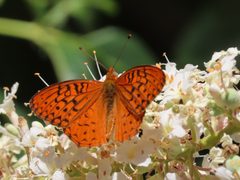
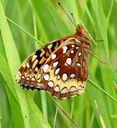
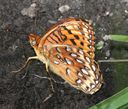
Speyeria hesperis hanseni is a of fritillary described in 1998. It belongs to the Speyeria, commonly known as the greater fritillaries, a group of large orange and black butterflies in the Nymphalidae. The subspecies was named in honor of California butterfly collector Chuck Hageman, recognized for his extensive field research on California butterflies. Like other Speyeria , it likely exhibits the typical fritillary with larvae feeding on violet family plants.
Pronunciation
How to pronounce Speyeria hesperis hanseni: /ˈspaɪəriə ˈhɛspərɪs ˈhænsiːnaɪ/
These audio files are automatically generated. While they are not always 100% accurate, they are a good starting point.
Images
Distribution
California, specifically in the Sierra Nevada Mountains region north and south of Yuba City.
Human Relevance
Named in honor of Charles "Chuck" Hageman of Yuba City, California, a prominent collector and researcher. Specimens of this are deposited at the Los Angeles County Museum of Natural History. Hageman left his extensive private butterfly collection, one of the largest in North America for Northern California butterflies, to several museums including UC Davis Bohart Museum and the McGuire Center for Lepidoptera and Biodiversity at the University of Florida.
Similar Taxa
- Speyeria callippeThe nominate or related subspecies in the same ; S. hesperis hanseni was described as a distinct subspecies within the Speyeria hesperis/callippe group based on Sierra Nevada
- Speyeria hesperisThe nominate ; S. hesperis hanseni was described as a distinct subspecies from Sierra Nevada previously included within S. hesperis
Sources and further reading
- BugGuide
- GBIF taxonomy match
- UC Davis Seminar: 'Insect Conservation in an Uncertain Future' | Bug Squad
- Meloidae Holdings | Entomology Research Museum
- Bohart Museum Butterfly Donor Chuck Hageman Leaves a Lasting Legacy | Bug Squad
- Two other orange and black butterflies: Variegated fritillary, Euptoieta claudia, and great spangled fritillary, Speyeria cybele — Bug of the Week
- The Eyes Have It: How Butterflies Navigate to Suitable Habitat
- “Natural” Oil Mosquito Repellents May Fend Off Mosquitoes—Briefly