
Titanoecidae
Lehtinen, 1967
Rock Weavers
Genus Guides
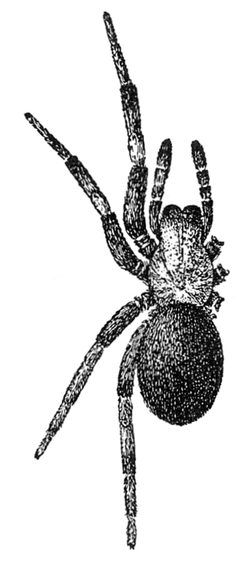
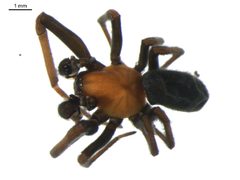
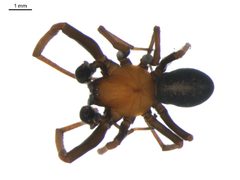
1Titanoecidae is a of cribellate spiders comprising five and approximately 67 . Members are primarily dark-colored web-builders that construct woolly, cribellate silk webs. The family occurs across the New World and Eurasia, with several species inhabiting high-altitude mountain environments where they can achieve high local abundance. The family was elevated from Amaurobiidae by Lehtinen in 1967.
Pronunciation
How to pronounce Titanoecidae: /tɪtəˈnɔɪsɪdiː/
These audio files are automatically generated. While they are not always 100% accurate, they are a good starting point.
Identification
Titanoecidae can be distinguished from similar cribellate by their dark coloration and the characteristic woolly texture of their silk, produced by the cribellum—a silk-producing organ with numerous fine spigots. The family is distinguished from Amaurobiidae by morphological features established in Lehtinen's 1967 revision, though specific diagnostic characters vary by . Members lack the distinctive markings or color patterns seen in many related cribellate families.
Images
Habitat
Several occur at relatively high altitudes in mountain ranges, where they may be very common. The shows broad across temperate and tropical regions, with species documented from lowland to montane elevations.
Distribution
New World and Eurasia. Specific records include: North America (USA), South America (Brazil, Argentina, Peru), Europe, Asia (India, Pakistan, Myanmar, China, Laos, Thailand, southern China, Hunan), Pacific Islands, Middle East (Iraq), and Africa (first records reported). The Pandava shows a remarkable range extension of approximately 3000 km from southern China to Iraq.
Behavior
Builders of cribellate (woolly) silk webs. One , Titanoeca quadriguttata, has been studied for conditional foraging and prey acceptance patterns.
Similar Taxa
- AmaurobiidaeFormerly included within Amaurobiidae; separated by Lehtinen in 1967 based on morphological differences. Both produce cribellate silk, requiring careful examination of genitalic and somatic characters for distinction.
- DictynidaeBoth are cribellate web-building spiders with dark coloration; distinguished by web architecture and morphological details of the cribellum and calamistrum.
Sources and further reading
- BugGuide
- Wikipedia
- GBIF taxonomy match
- iNaturalist taxon
- NCBI Taxonomy
- Catalogue of Life
- Revision of the Asian spider genus Pandava Lehtinen (Araneae: Titanoecidae): description of five new species and first record of Titanoecidae from Africa
- On the poorly known genus Anuvinda Lehtinen, 1967 (Araneae: Titanoecidae)
- Prey acceptance and conditional foraging behavior in the cribellate-web spider Titanoeca quadriguttata (Araneae: Titanoecidae)
- Unraveling the mysteries of Goeldia Keyserling, 1891: revision, description of seven new species and first record from USA (Araneae: Titanoecidae)
- First record of Pandava Lehtinen, 1967, in the Middle East, with a new record of Nurscia albomaculata (Lucas, 1846) (Araneae: Titanoecidae) from Iraq