
Clivina collaris
(Herbst, 1784)
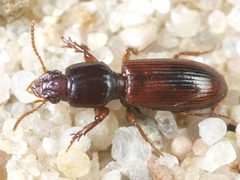
Clivina collaris is a ground beetle in the Scaritinae, first described by Herbst in 1784. The species possesses a chemical defense mechanism involving the release of defensive compounds through a complex muscular system when subjected to pressure, such as being stepped upon. Contact with these chemicals can cause minor skin irritation and temporary discoloration that persists despite washing with soap, though effects typically subside within approximately 30 minutes. The species has been recorded across a broad geographic range including North America and parts of Europe and western Asia.

Pronunciation
How to pronounce Clivina collaris: /klɪˈviːnə kəˈlɛərɪs/
These audio files are automatically generated. While they are not always 100% accurate, they are a good starting point.
Images
Distribution
Recorded from Canada, the United States, (former) Yugoslavia, Albania, and Armenia. The transatlantic distribution pattern suggests either natural range disjunction or possible human-mediated , though specific mechanisms remain unconfirmed.
Behavior
When subjected to pressure (such as being stepped on), the releases defensive chemicals through a complex muscular system. This represents an active chemical defense mechanism triggered by mechanical stimulation.
Human Relevance
Contact with released defensive chemicals may produce minor burning sensation on skin and cause temporary discoloration resembling dye staining. Regular soap washing does not remove the coloration. Effects are generally mild, with some individuals reporting no irritation, and skin texture typically returns to normal within approximately 30 minutes. No serious medical concerns have been documented.
More Details
Chemical Defense Mechanism
The possesses a complex muscular system specifically adapted for chemical defense release under pressure. This appears to be a passive defense triggered by external mechanical force rather than active spraying.