

Where do all the go when it gets cold?
It feels like a reasonable question when the disappear and the porch light stops attracting its usual crowd. Did they die? Go underground? Are there several thousand beetles quietly waiting inside the walls?
Depending on the some of those guesses are pretty close. Insects and their relatives have several ways of getting through winter, and many stay much closer than you might expect. The animal you saw in August might still be nearby, or it might have died after leaving behind the that will survive until spring.12
And then there are the bugs you can find around on the snow.
Winter looks different when you're bug-sized
Most insects are meaning their body temperature depends heavily on their surroundings. As temperatures drop, their movements and development generally slow down. Winter also brings a food problem: even an animal that survives the cold still has to get through a season when its usual meals may be unavailable.34
One solution is to find a better place to wait. Soil, loose bark, fallen leaves, and dead plant material offer shelter. A underground experiences different conditions from an aphid egg sitting on a twig, even if they're only a few feet apart.1
Snow can actually help. A layer of snow insulates the ground underneath it, buffering the animals below from colder air above. For an insect tucked into the soil or vegetation, a snowy winter can offer more protection than a bare, exposed one.1
So when you check the weather and see a brutally cold overnight low, that doesn't tell you exactly what every bug in the yard experienced.
Do insects hibernate?
You'll often hear people describe insects as hibernating. That's useful everyday shorthand, but there are different biological processes hiding under that description.
is a programmed pause in development or In many species, seasonal cues such as changing day length help trigger it before conditions become unfavorable. Depending on the species, an insect might enter diapause as an egg, an insect, a pupa, or an whose reproduction is put on hold.34
During diapause, metabolism is often reduced, and the animal relies on stored resources. But diapause isn't simply what happens whenever an insect gets cold. It can persist even when conditions briefly improve, and some species use it to get through hot or dry seasons.3
Another response is , a pause in activity or development caused directly by unfavorable conditions such as cold. An insect in quiescence can resume activity and development when conditions improve. This quicker stop-and-start response can let insects take advantage of a warm spell in the middle of winter.4
The distinction gets especially interesting with monarch butterflies. Eastern North America's migratory monarchs to Mexico for winter while in reproductive diapause. They're capable of flying a long way while reproduction is delayed. Being in diapause doesn't automatically mean being motionless.5
and diapause can work together. So can shelter and cold These are overlapping tools, rather than a menu where every species picks exactly one.
Sometimes the adult dies, but the next generation stays
When people ask whether bugs survive winter, they're usually picturing the adults they recognize. But the animal may look nothing like that.
Here are a few examples from temperate North America:
| Animal | What spends the winter? | Where? |
|---|---|---|
| Soybean aphid | Eggs | On buckthorn twigs.1 |
| Woolly bear caterpillar | The caterpillar | Sheltered in fallen leaves.6 |
| Swallowtail butterfly | A pupa | A chrysalis camouflaged to resemble a dried leaf.6 |
| Mourning cloak butterfly | The adult butterfly | Under bark or in other small crevices.7 |
| Black-and-yellow garden spider | The next inside an egg sac | The sac remains attached to vegetation after the adults die in fall.2 |
There isn't one universal winter stage, even among butterflies and An empty-looking garden can still contain eggs, caterpillars, pupae, and sheltered adults. Looking only for flying insects misses much of what's there.67

Image by Donald Hobern
Rights: CC BY 2.0
How do they keep from freezing?
Finding shelter helps, but some overwintering insects still experience temperatures below the freezing point of water. Their bodies need ways to handle that.
Some use freeze avoidance. They keep their body fluids liquid below 32°F or 0°C, a condition called supercooling. Depending on the species, preparations can include accumulating protective substances such as glycerol and removing material from the gut that could help ice crystals start forming.8
Other insects are freeze tolerant. They can survive ice forming in parts of their bodies, generally in the fluid outside their Protective compounds and control over ice formation help limit damage. The location of the ice matters; this isn't the same as every cell freezing into a little ice cube.9
Goldenrod gall flies, Eurosta solidaginis, are a good example. Their larvae spend winter inside swellings called galls on goldenrod stems, and they can survive the freezing of extracellular body fluids. A different goldenrod resident, the gall moth Epiblema scudderiana, uses a freeze-avoidance strategy instead.9
Even neighbors inside similar plant structures can solve the cold problem differently.

Image by Beatriz Moisset
Rights: CC BY-SA 2.5
Diapause and cold hardiness are related in many insects, but they aren't interchangeable. Pausing development doesn't, by itself, make an insect freeze-proof. Cold can also cause injury without the animal actually freezing.8
What about spiders?
Spiders also have a variety of winter schedules. Depending on the species, they can overwinter as eggs, spiderlings, or adults. Some juveniles and adults shelter in bark or the ground and enter diapause. Spiders living in houses may remain active through winter.2
For the black-and-yellow garden spider, Argiope aurantia, the familiar adult doesn't make it through to spring. The female leaves behind an egg sac, and the young emerge the following year. Other species survive winter as living, mobile spiders.2
A spider in the house in January may simply be living its usual indoor life.2
The bugs that come out in winter
Some winter sightings happen because a warm afternoon lets a sheltered animal become active. Others involve species whose normal lives include cold weather.
Snow fleas
If a patch of snow looks like someone sprinkled pepper over it, take a closer look. If the pepper jumps, you may have found snow
These are springtails, small classified separately from insects. Despite the name, they aren't biting fleas. Snow fleas, including Hypogastrura harveyi, can gather on melting snow, especially around tree bases in late winter.1011
They spend much of their time in soil and leaf litter, feeding on things such as fungi, and decaying organic material. Their jumping comes from a forked appendage under the body called a Release it, and the animal launches itself away.10
The white background makes animals that are easy to overlook in summer suddenly very noticeable.

Image by Bill Keim
Rights: CC BY 4.0
Winter stoneflies
Streams have their own winter insect life. Stoneflies spend their immature stages in water, and some species emerge as adults while ice is still present. These winter include members of the Capniidae and Taeniopterygidae.12
You may find adults near the water, on streamside surfaces or around the ice. Winter is part of their normal life cycle. Below the surface, stonefly nymphs can also remain active in water that hasn't frozen solid.12
An icy stream can have a lot more going on than the view from the bank suggests.

Image by Bob Henricks
Rights: CC BY-SA 2.0
Wingless snow flies
Snow flies in the Chionea look a little like someone forgot to finish assembling a crane fly. They have long legs and no functional wings, and the adults walk across snow.13
Their cold tolerance has a particularly dramatic limit. In experiments, researchers watched snow flies shed legs after ice began forming in them. Losing the limb could prevent the ice from spreading into the rest of the body and prolong survival under the experimental conditions.13
This doesn't make them immune to freezing. Freezing through the body was almost always fatal in the study. Their ability to remain coordinated in the cold, and sometimes abandon a freezing leg, helps them keep going where many other insects would already be incapacitated.13

Image by B. Staffan Lindgren
Rights: CC BY 4.0
Butterflies on warm winter days
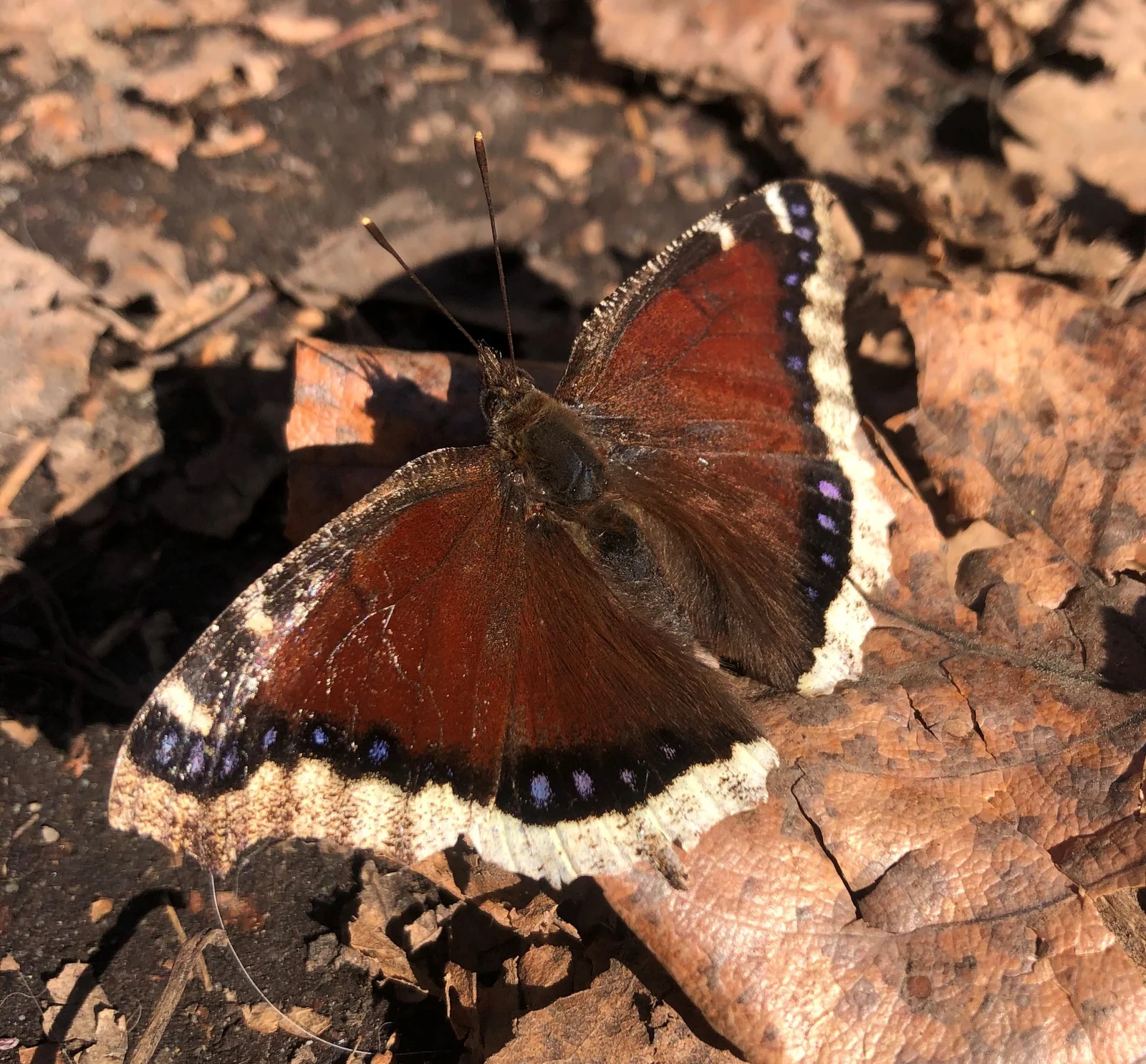
A butterfly in winter can be perfectly normal, too. Mourning cloaks, the dark butterflies with pale yellow wing borders pictured at the top of this post, overwinter as adults. On warm winter days they may fly, and in spring they can appear while snow is still on the ground.714
They also feed on tree sap and other foods, visiting flowers only occasionally. An early butterfly doesn't necessarily need a garden full of blooms to find a meal.14
Ticks are another reminder that winter activity isn't limited to insects. These arachnids can be active during suitable above-freezing weather, so a winter date on the calendar doesn't guarantee that they're inactive.15
Bees don't all spend winter the same way
For many North American bumble bees, the colony's winter survival comes down to newly mated The old queen, and males die as the season ends. The new queens shelter through winter, living on stored reserves, then establish colonies the following spring.16
Honey bees take a different approach. A colony can persist through winter as a group. Workers form a cluster and generate heat, consuming stored food to fuel the effort. They may also leave the hive during warm winter weather.17
Many solitary spend the season inside their nests in soil, wood, or other cavities. The bees you saw visiting flowers may be gone, while their offspring remain protected in the places where the females nested.17
A little winter mess gives bugs somewhere to stay
Once you know where overwintering animals are, the dead-looking parts of a yard start to look different. Fallen leaves are shelter. Old stems and pieces of wood can contain nest cavities. The empty flower bed may already be holding some of next year's insects.18
Leaving some leaves in garden beds or around trees, keeping a brush pile where practical, and retaining some standing stems can preserve those spaces. If leaves need to move, keeping them intact helps protect animals and life stages that may already be in them.18
And if you're looking for bugs during winter, try watching the snow around tree bases on a mild day, or checking surfaces beside a stream without disturbing the A hand lens makes the tiny ones much easier to appreciate.1012
You might find a launching itself off the snow, a stonefly looking for a mate, or a butterfly taking advantage of the sun. Plenty of their neighbors will still be tucked away, waiting.
Footnotes
University of Minnesota — Where do our field crop insects go in the winter? ↩ ↩2 ↩3 ↩4
Illinois Department of Natural Resources — Where Do They Go in Winter? ↩ ↩2 ↩3 ↩4 ↩5
NC State University, General Entomology — Survival Strategies ↩ ↩2 ↩3
David L. Denlinger — Insect Diapause: Confronting the Challenges of a Seasonal Environment (book excerpt) ↩ ↩2 ↩3
U.S. Fish & Wildlife Service — Monarch: behavior and life cycle ↩
Xerces Society — Leave the Leaves: Winter Habitat Protection ↩ ↩2 ↩3
University of Minnesota Department of Entomology — Mourning Cloak ↩ ↩2 ↩3
Iowa State University, Dean and Hodgson — Cold Hardiness of Insects and the Impact of Fluctuating Temperatures ↩ ↩2
Storey and Storey — Chaperone proteins: universal roles in surviving environmental stress ↩ ↩2
University of Minnesota Department of Entomology, Jeff Hahn — Snow Flea ↩ ↩2 ↩3
Government of the Northwest Territories — Stoneflies ↩ ↩2 ↩3
Golding and colleagues, Current Biology — Snow flies self-amputate freezing limbs to sustain behavior at sub-zero temperatures ↩ ↩2 ↩3
Pennsylvania Department of Health — Learn More About Ticks ↩
Texas Parks and Wildlife Department — Bumble Bee Life-Cycle ↩
Colorado State University Extension, Lisa Mason — Meant to Bee: Overwintering Strategies for Bees ↩ ↩2
National Park Service — I Didn't Know That!: Leave the Leaves ↩ ↩2