


If a butterfly gets caught in the rain, is that the end for the butterfly?
It can look that way when one is sitting motionless after a storm. Those wings seem awfully delicate, and a raindrop is a substantial object when you're that small. But can dry out after rain and fly again. Their wings also have surfaces that help them shed water in the first place.12
Cicadas have their own water-repelling wing structures. Some can even get rid of tiny droplets by making them jump off the surface.34
So why does getting wet sometimes ground an insect, while other can survive a flood? The answer depends on where the water ends up, how long it stays there, and which animal we're talking about.
Getting wet means several different things
Water can touch an insect without spreading across its surface. On a hydrophobic, or water-repelling, surface, a droplet tends to bead up. On some insect wings, tiny surface structures help keep it from entering the spaces in the texture underneath. Researchers call especially water-repellent surfaces superhydrophobic.3
That makes a brief splash different from being covered in clinging water. Water that stays attached adds weight, and contact with cold water can carry heat away. Both matter to an animal trying to fly.5
Then there's submersion. A water-repelling wing doesn't automatically give the rest of the insect a way to breathe underwater. Most terrestrial insects get air through small openings along the body connected to a branching system of respiratory tubes. Losing access to an oxygen supply is a different problem from having a few droplets on a wing.67
A shower, a soaked butterfly, and a trapped in a flooded burrow aren't experiencing the same emergency.
Cicada wings can shed water and clean themselves
A wing looks smooth until you examine it at a much smaller In the studied, its wing surface was found to carry arrays of tiny pillars. Their dimensions and arrangement, together with the surface chemistry, affect how readily water wets the wing.3
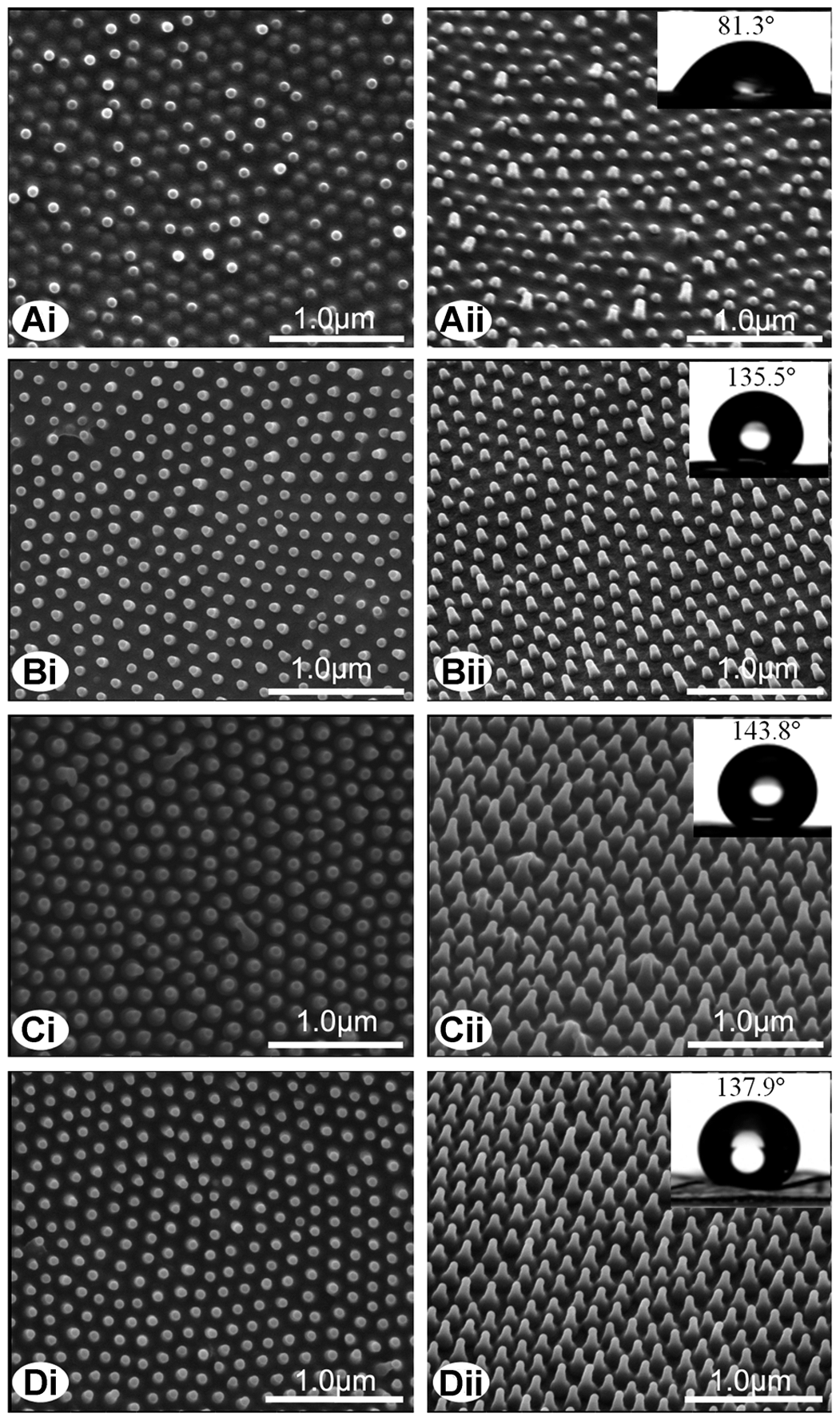
Cicada wings under an electron microscope. Each row shows a different species; the inset photographs show how water sits on its wing surface. Figure 1 from Sun and colleagues (2012), PLOS ONE, used under CC BY 4.0. Open the full-size figure.
Some cicadas take water shedding a step further. In experiments with Psaltoda claripennis, researchers watched water condense into tiny droplets on the wings. When droplets joined together, the merger released surface energy, enough to launch the combined droplet away. Some departing drops carried particles with them, cleaning the wing without the insect having to scrub it.4 The cicada isn't flicking each drop away, the water and the wing surface do the work.
But cicadas don't all have equally water-repellent wings. A comparison of four species found superhydrophobic wings in three, while the periodical cicada septendecim was only moderately hydrophobic.3
What happens to wet butterfly wings?
Butterfly wings have overlapping scales with fine surface structures. In some species, this textured, water-repelling surface can help break an incoming drop into smaller droplets.2
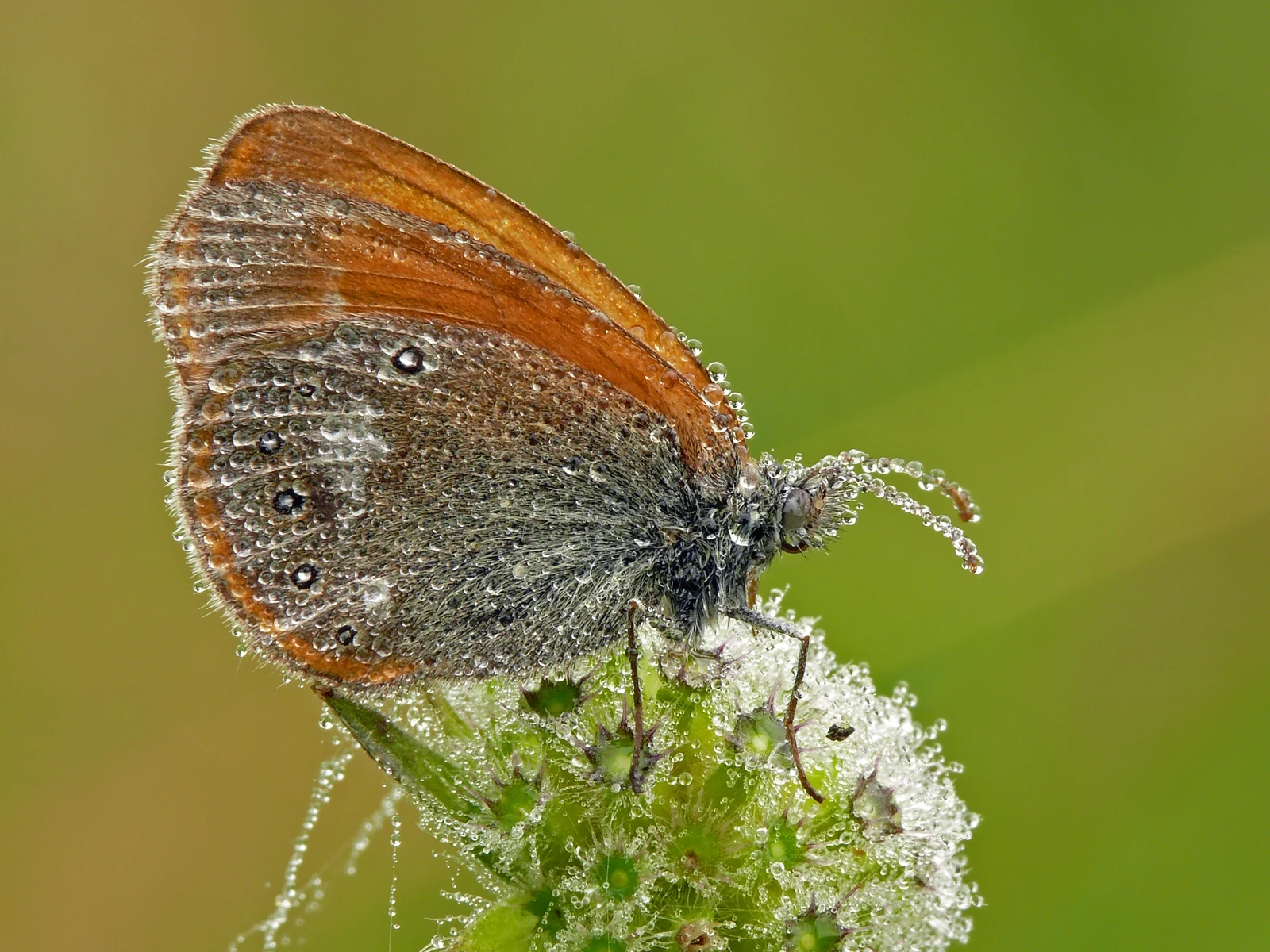
Morning dew on a chestnut heath butterfly, Coenonympha glycerion. The droplets remain visibly beaded on its surface.
Image by Darius Baužys
Rights: CC BY 3.0
In a 2020 study, researchers dropped water onto biological surfaces, including zebra swallowtail and cracker butterfly wings. High-speed recordings showed the spreading water developing waves and holes before breaking apart. Under the tested conditions, fragmentation shortened the time water remained in contact with the surface. The researchers proposed that this could help explain benefits such as maintaining stability.2
If enough water remains on a butterfly, flight can still become difficult. Chicago Botanic Garden staff describe butterflies hanging to dry after rain, then becoming active again as conditions improve. Getting wet doesn't automatically mean the wings are permanently ruined.1
Butterflies also avoid exposure. Depending on the species and available cover, they may shelter beneath leaves, inside vegetation, or in other protected places. Cool, cloudy weather can keep them grounded even after rain stops, because their flight muscles need sufficient warmth to work.8
Sometimes, waiting under a leaf is a very effective
Wet and cold can be a dangerous combination
For monarch butterflies, wetting can become a survival problem. Experiments found that monarchs with water on their bodies froze at warmer subzero temperatures than dry monarchs. Forest cover helped protect the butterflies from precipitation and from cooling beneath an open night sky.9 A butterfly drying after a summer shower very different conditions from a wet monarch exposed to freezing weather. The temperature, shelter, and duration of exposure matter.19
How does a mosquito survive a direct hit?
For a flying mosquito, one problem is the collision itself. A large raindrop can outweigh it many times over. You might expect the impact to be fatal.10
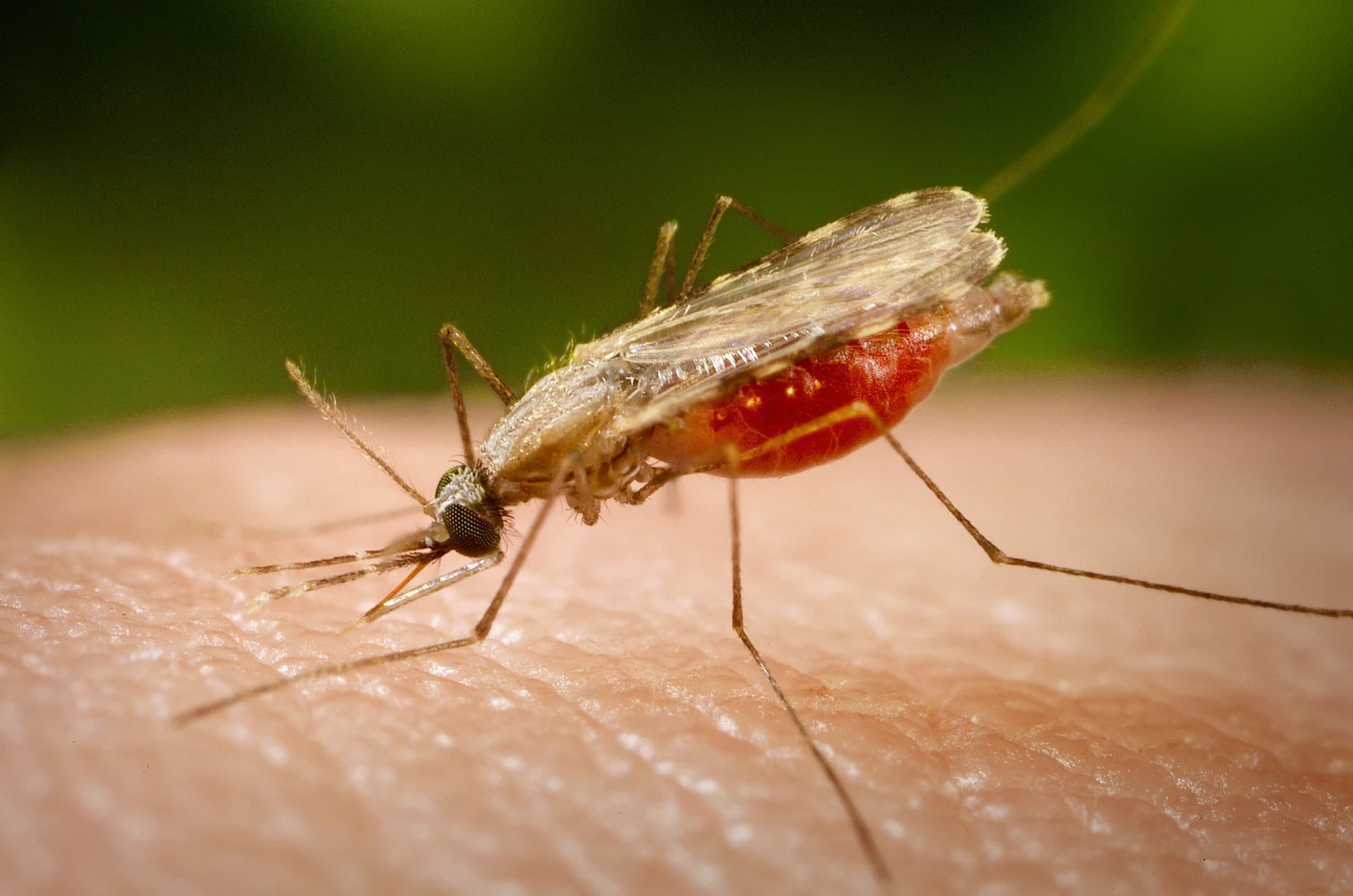
Anopheles minimus, a member of the mosquito genus used in the raindrop-impact research. This photograph shows an adult feeding.
Image by James Gathany / CDC
Rights: Public domain
High-speed experiments found that mosquitoes could survive direct hits partly because they were so light. The falling drop lost relatively little momentum when it struck one. Instead of stopping abruptly against the insect, it carried the mosquito downward. The mosquito could then separate from the water and recover its flight.10
Glancing impacts could spin mosquitoes around, and they recovered from those, too. Their small mass and sturdy helped them withstand the encounter.10
There were limits. Being driven downward near the ground could cause a second collision or leave the mosquito trapped in water. Surviving the drop's impact doesn't guarantee surviving wherever that drop takes you.10
What about insects that live on the ground?
Terrestrial, or ground dwelling, insects have a protective outer covering called the Lipids, including waxy compounds at its surface, help limit water movement through it. Much of the research on this barrier concerns the opposite problem: keeping an insect's own water from escaping into dry air.11
But a protective outer surface doesn't make an insect a sealed container. It still needs to exchange respiratory gases. Once its surroundings flood, survival depends on whether it can keep an air supply, obtain oxygen another way, or tolerate the changed conditions.67
Some land-dwelling insects have surprisingly effective responses.
Fire ants turn the colony into a raft
Red imported fire Solenopsis invicta, can link their bodies into floating rafts during floods. Each ant's surface is somewhat water-repellent, but the assembled raft repels water more strongly than an individual ant. The structure traps air among the ants and helps keep the group afloat.12
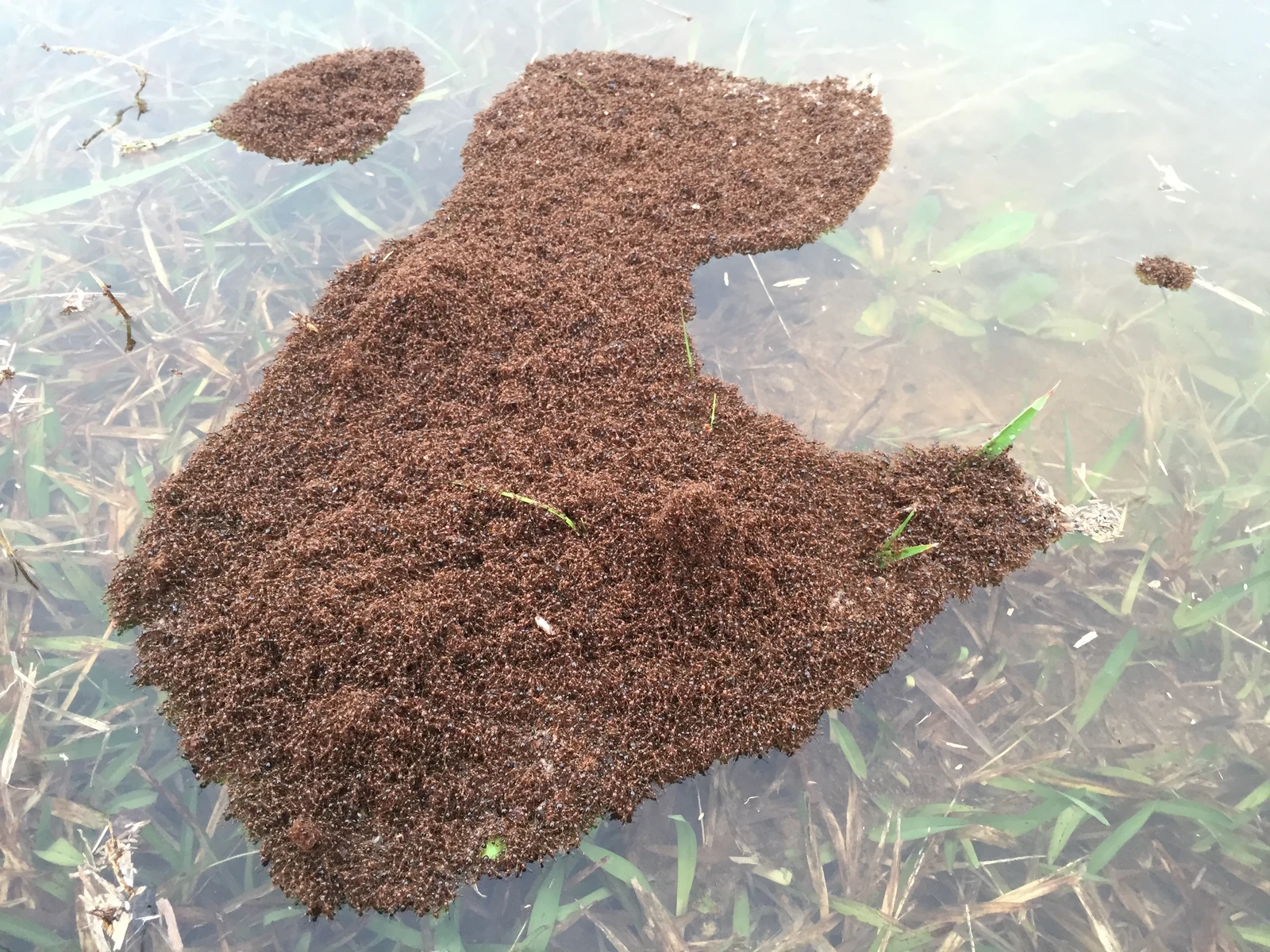
A fire-ant raft after heavy rain flooded a pond bank in North Carolina. The ants are anchored to grass projecting above the water.
Image by TheCoz
Rights: CC BY-SA 4.0
That trapped air also helps ants at the bottom of the raft breathe. A flood-survival strategy emerges from the insects' surfaces, the spaces between their bodies, and their together.12
Dormant bumblebee queens can survive submersion
Some bumblebee spend winter underground in a seasonal state of suppressed activity and development. That raises an obvious question: what happens if their winter chamber floods?
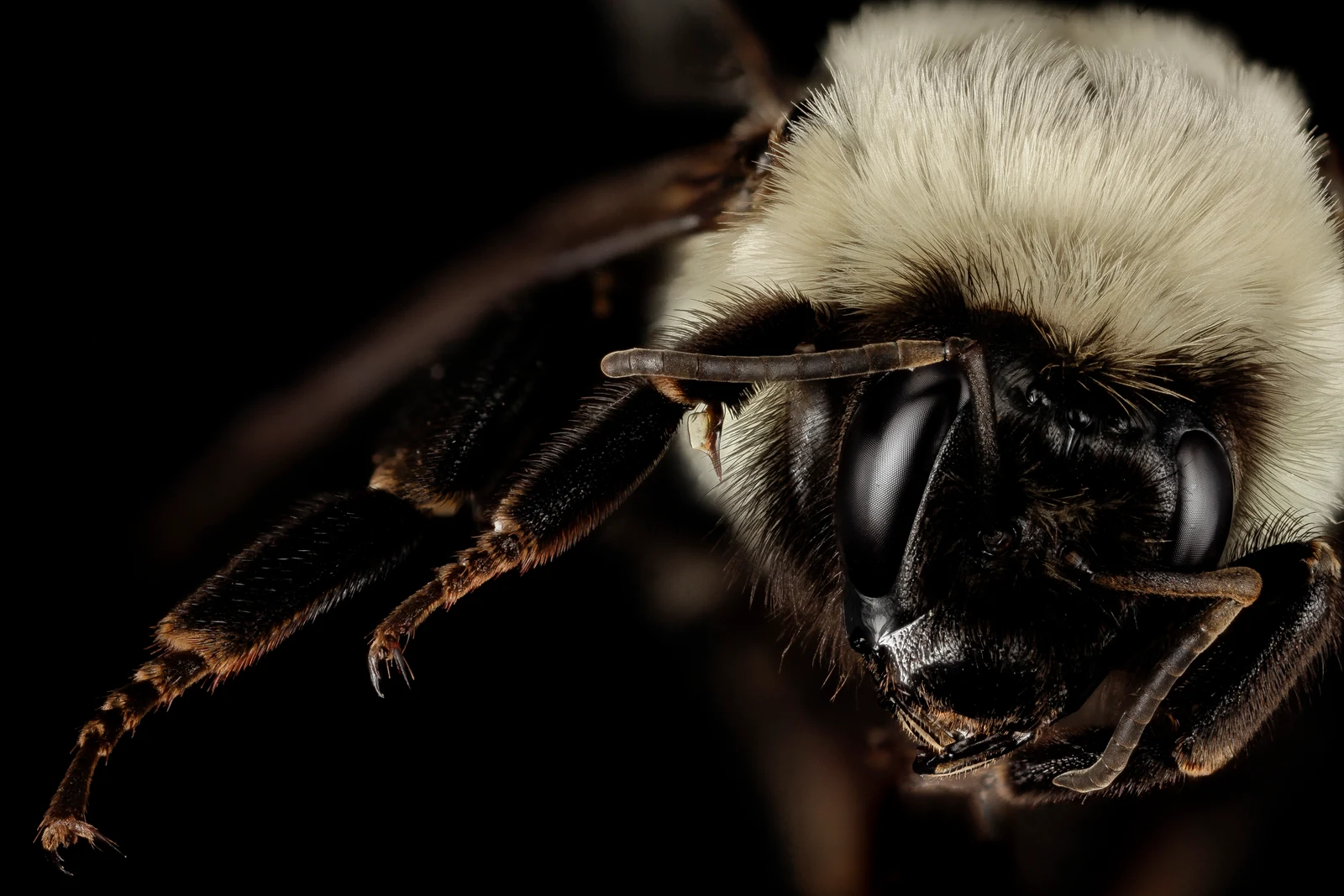
A common eastern bumblebee queen, Bombus impatiens, photographed as a specimen. The flooding studies below tested dormant queens of this species.
In a 2024 experiment, common eastern bumblebee queens, Bombus impatiens, survived up to a week of submersion under cold overwintering conditions. Survival did not differ significantly among the tested flooding treatments and controls during subsequent monitoring.13
A 2026 follow-up investigated how they managed it. The researchers found evidence of oxygen uptake from the surrounding water, production of energy through anaerobic that don't require oxygen, and greatly reduced metabolism. The queens combined several ways of meeting a very low energy demand.14
Some soil bugs wear a layer of air
Springtails are tiny, six-legged relatives of insects, usually classified separately from insects themselves. Many live in soil, decaying material, or on plants, where temporary flooding can be part of life.15
Their outer surface has bristles and intricate microscopic patterns that resist wetting. Researchers have observed persistent layers of trapped air around submerged Such an air layer is called a For animals that rely heavily on gas exchange across their body surface, keeping water from forming a continuous film is especially useful.15
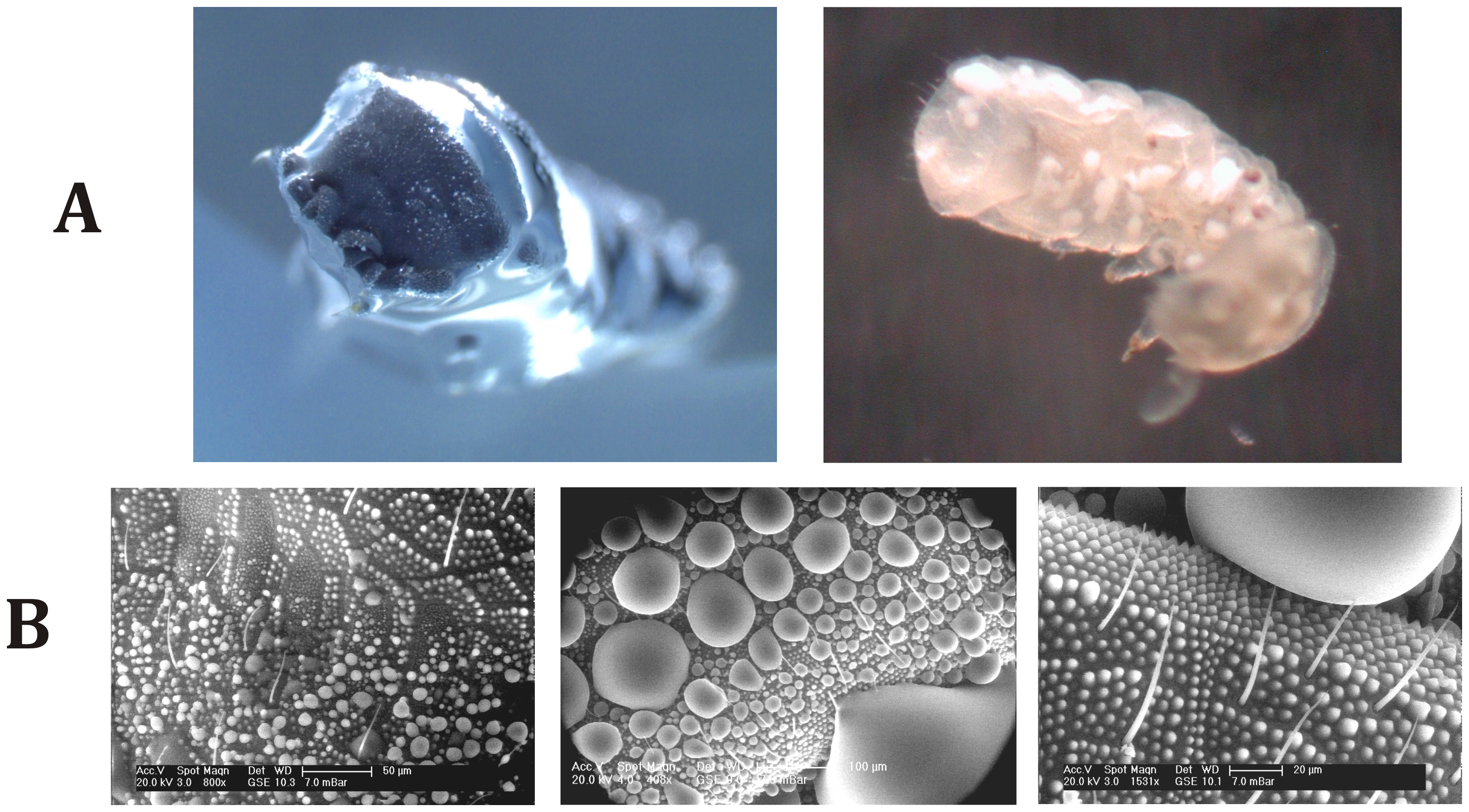
Trapped air appears as a shiny layer around the springtails in panel A: the left animal is in water, and the right is in ethanol. Panel B shows condensation droplets on springtail skin. Figure 2 from Helbig, Nickerl, Neinhuis, and Werner (2011), PLOS ONE, used under CC BY 4.0. Open the full-size figure.
A plastron can do more than hold a fixed supply of air. In suitable conditions, dissolved oxygen can diffuse from the surrounding water into the air layer as the animal uses oxygen. This makes it a physical gill. Some aquatic insects, including riffle beetles, use this principle to remain submerged.7
Other aquatic insects solve the oxygen problem differently. Diving beetles can carry an air bubble, while and young have gills that take up dissolved oxygen. Life underwater requires adaptations beyond shedding droplets from a wing.7
Conclusion
The next time you find a butterfly sitting quietly after rain, watch what happens as the weather improves. It may simply be waiting to dry and warm up.18 And if you spot beads of water on a cicada wing, you're looking at a microscopic texture that changes how water behaves.34
Sources
Footnotes
Gabriella Rodriguez, Chicago Botanic Garden — The Best Time to See Butterflies Fight? Observations of butterflies drying and resuming activity after rain. ↩ ↩2 ↩3 ↩4
Kim and colleagues (2020) — How a raindrop gets shattered on biological surfaces. Proceedings of the National Academy of Sciences. High-speed drop-impact experiments on insect wings and other surfaces. ↩ ↩2 ↩3
Oh and colleagues (2017) — Exploring the Role of Habitat on the Wettability of Cicada Wings. ACS Applied Materials & Interfaces. Comparison of wing structures, water repellency, and droplet jumping in four cicada species. ↩ ↩2 ↩3 ↩4 ↩5
Wisdom and colleagues (2013) — Self-cleaning of superhydrophobic surfaces by self-propelled jumping condensate. Proceedings of the National Academy of Sciences. Condensation and particle-removal experiments on cicada wings. ↩ ↩2 ↩3
Cornell University — Armor on butterfly wings protects against heavy rain. The research team's explanation of water shedding, added weight, and heat transfer. ↩
NC State University, General Entomology — Respiratory System. ↩ ↩2
NC State University, General Entomology — Respiration in Aquatic Insects. Air bubbles, plastrons, gills, and other ways insects obtain oxygen underwater. ↩ ↩2 ↩3 ↩4
Michael Raupp — What do butterflies do when it rains? An entomologist's explanation of rain shelter and the temperature requirements of butterfly flight. ↩ ↩2
Anderson and Brower (1996) — Freeze-protection of overwintering monarch butterflies in Mexico: critical role of the forest as a blanket and an umbrella. Ecological Entomology. ↩ ↩2
Dickerson and colleagues (2012) — Mosquitoes survive raindrop collisions by virtue of their low mass. Proceedings of the National Academy of Sciences. ↩ ↩2 ↩3 ↩4
Gibbs (2011) — Thermodynamics of cuticular transpiration. Journal of Insect Physiology. Review of water movement through the cuticle and the role of surface lipids. ↩
Mlot, Tovey, and Hu (2011) — Fire ants self-assemble into waterproof rafts to survive floods. Proceedings of the National Academy of Sciences. ↩ ↩2
Rondeau and Raine (2024) — Unveiling the submerged secrets: bumblebee queens' resilience to flooding. Letters. ↩
Darveau, Rondeau, and Rojas (2026) — Diapausing bumble bee queens avoid drowning by using underwater respiration, anaerobic metabolism and profound metabolic depression. Proceedings of the Royal Society B. ↩
Helbig and colleagues (2011) — Smart Skin Patterns Protect Springtails. PLOS ONE. ↩ ↩2